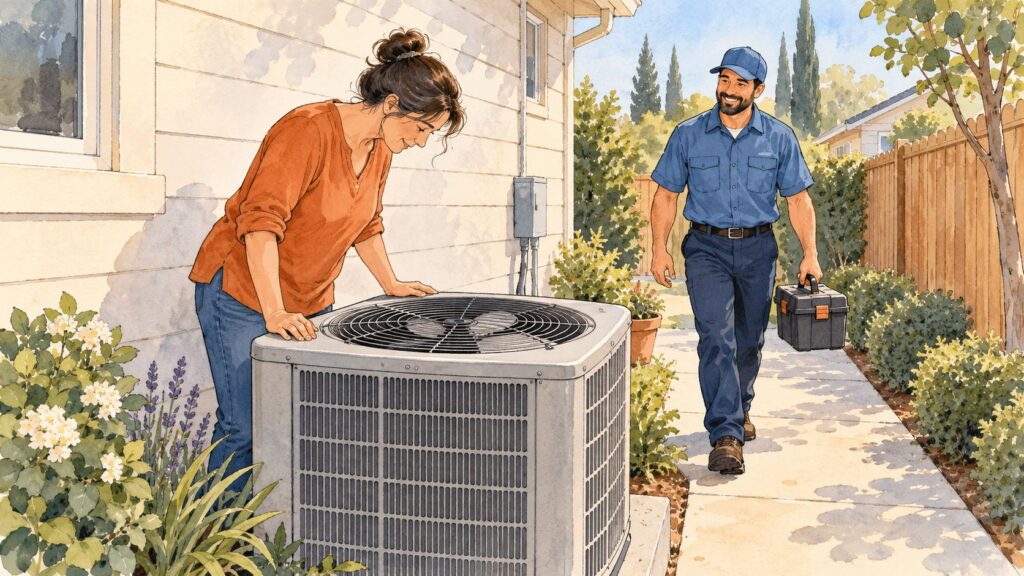
It’s a Saturday afternoon in August, the thermostat reads 78, and the house says otherwise. You walk out to the side yard and the outdoor unit is humming away like it’s earning its keep. Then you look down through the grille and the fan blade is sitting perfectly still.
An AC fan not spinning while the unit hums is one of the most common things we hear about during a Sacramento Valley summer. Usually the culprit is a small electrical part called the run capacitor. Sometimes it’s the contactor. Sometimes it’s the fan motor itself, worn out after fifteen summers of hundred degree afternoons.
But the diagnosis is the second thing that matters. Here’s the first: if the outdoor fan isn’t turning, your compressor is probably still running, and it’s cooking itself right now. So before you keep reading, go set your thermostat to off. Not fan only. Not a couple of degrees warmer. Off.
Why a still fan blade is urgent
Your outdoor fan has one job. It pulls air across the condenser coil so the heat your system just took out of your living room has somewhere to go. When the blade stops, that heat stays put and pressure inside the system climbs.
The compressor, the most expensive component you own, keeps pumping refrigerant into a coil that can’t shed heat. Some systems have a high pressure switch that trips and saves you. Plenty of older ones don’t, and the compressor runs until something gives.
On a 104 degree Elk Grove afternoon that happens fast. We’ve seen homeowners let a humming unit run for two hours because the house still felt sort of cool, and turn a straightforward capacitor repair into a compressor replacement conversation. Shutting the thermostat off costs you nothing.
Which fan actually stopped, the one outside or the one inside
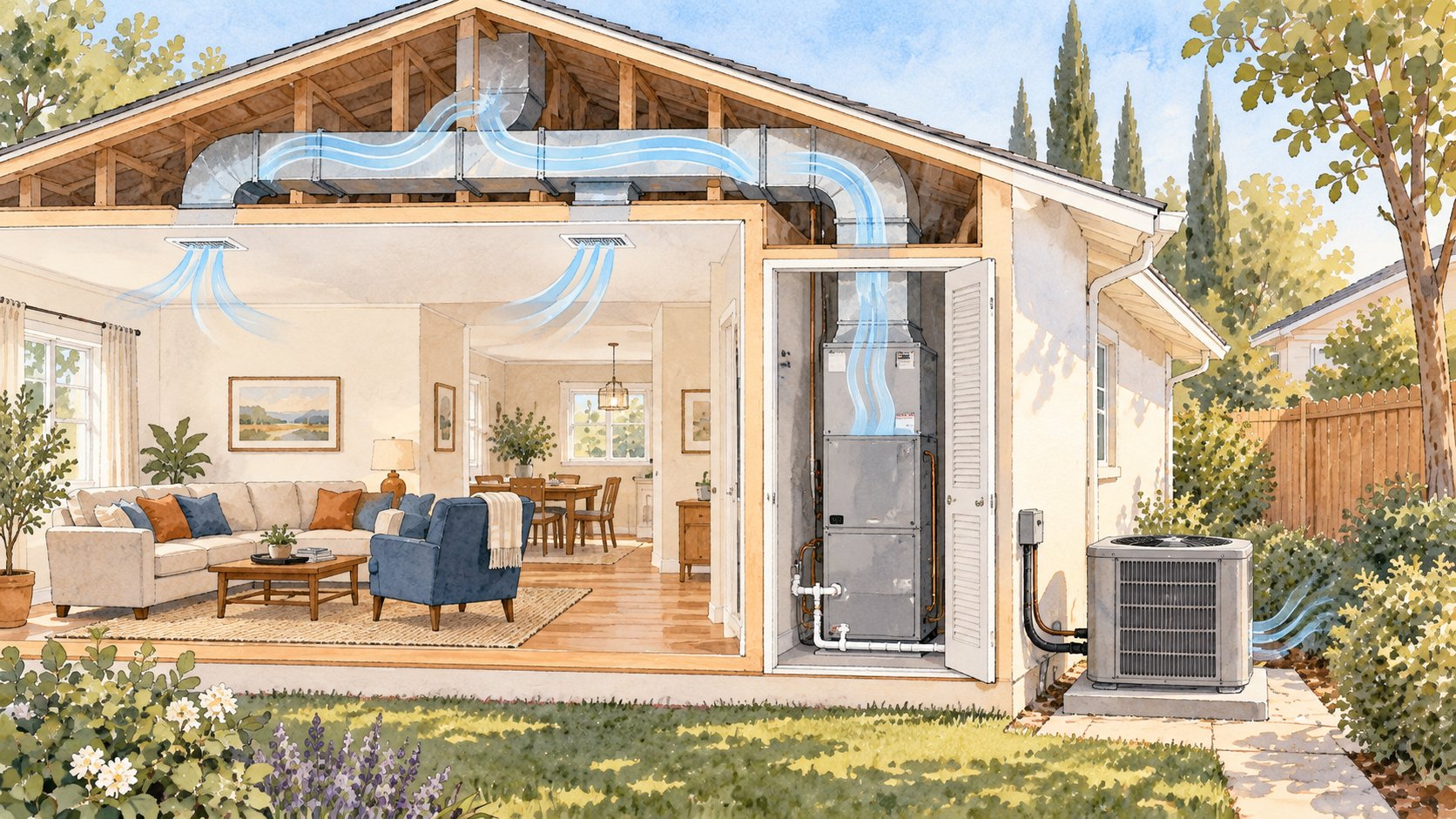
Your system has two fans, and figuring out which one quit narrows the problem fast. The condenser fan sits in the outdoor unit beside your house, visible through the grille on top, and its job is dumping heat outdoors. The blower lives indoors in your furnace or air handler, often in a closet or the attic, pushing conditioned air through your ducts.
Stand at a supply vent with the system calling for cooling. If you feel air moving, your blower is fine and the trouble is outside. Dead quiet vents with the outdoor unit running means the problem is indoors. Nothing happening in either place usually points to power or controls instead.
AC fan not spinning: seven common causes
Nearly every case traces back to one of these. They range from a two minute fix to a repair you shouldn’t attempt.
1. A failed run capacitor
This is the big one. The capacitor stores a charge and gives the motor the shove it needs to break inertia. When it weakens, the motor gets power but can’t get moving, so it sits there humming and heating up. A hum with a motionless blade points at the capacitor more often than anything else. More in our guide to why AC capacitors fail so often.
2. A worn contactor
The contactor is the heavy duty relay that switches power to the outdoor unit when the thermostat calls for cooling. Its contacts pit and burn over the years, so a failing one delivers power in bursts or never engages. Ants love crawling into contactors, which is a real problem in Elk Grove yards.
3. A burned out fan motor
Bearings dry out and seize, windings overheat, and eventually the motor is done. A grinding or squealing noise in the weeks beforehand points here.
4. A tripped breaker or blown fuse
Check your electrical panel and the small disconnect box near the outdoor unit. A breaker that trips once might be a surge. A breaker that trips again right after a reset is telling you something is wrong, and resetting it a third time is how electrical fires start. Stop and call someone.
5. Debris jamming the blade
Leaves, a stray branch, a chunk of bark from the mulch bed, or a bird’s nest can physically block the blade. This is the one cause a homeowner can usually clear safely, as long as the power is off first.
6. A frozen coil or an overheat shutdown
A clogged filter or low refrigerant can ice over the indoor coil, choke airflow, and push the system into a protective shutdown. Many motors also have a thermal overload that cuts power when they run too hot, then resets once they cool. If your fan quits after twenty minutes and comes back an hour later, that’s often what you’re seeing. Our post on frozen AC coils covers the pattern.
7. A thermostat or control board problem
Less common, but it happens. A dead thermostat battery, a loose low voltage wire, or a failing control board can mean the outdoor unit never gets the signal to start. Cheap to rule out first.
What you can safely check yourself
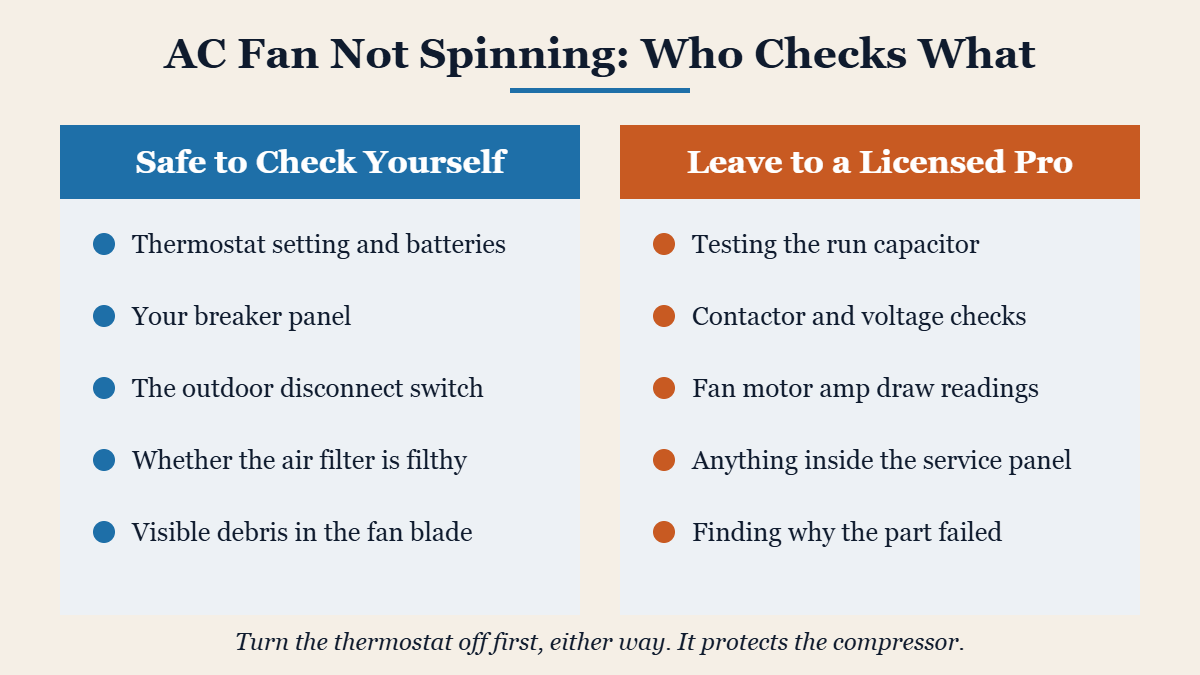
Safe to check: the thermostat setting and batteries, your breaker panel, the outdoor disconnect switch, whether the air filter is filthy, and whether anything visible is jammed in the blade with power off at the disconnect.
Not safe, ever: opening the electrical service panel on the outdoor unit. A capacitor can hold a lethal charge long after the power is cut, and the internet is full of confident advice from people who’ve never seen what that does to a hand. The old trick of spinning the blade with a stick tells a technician nothing they can’t learn safely with a meter, and it puts your fingers near a blade that could start without warning.
What a real diagnosis looks like
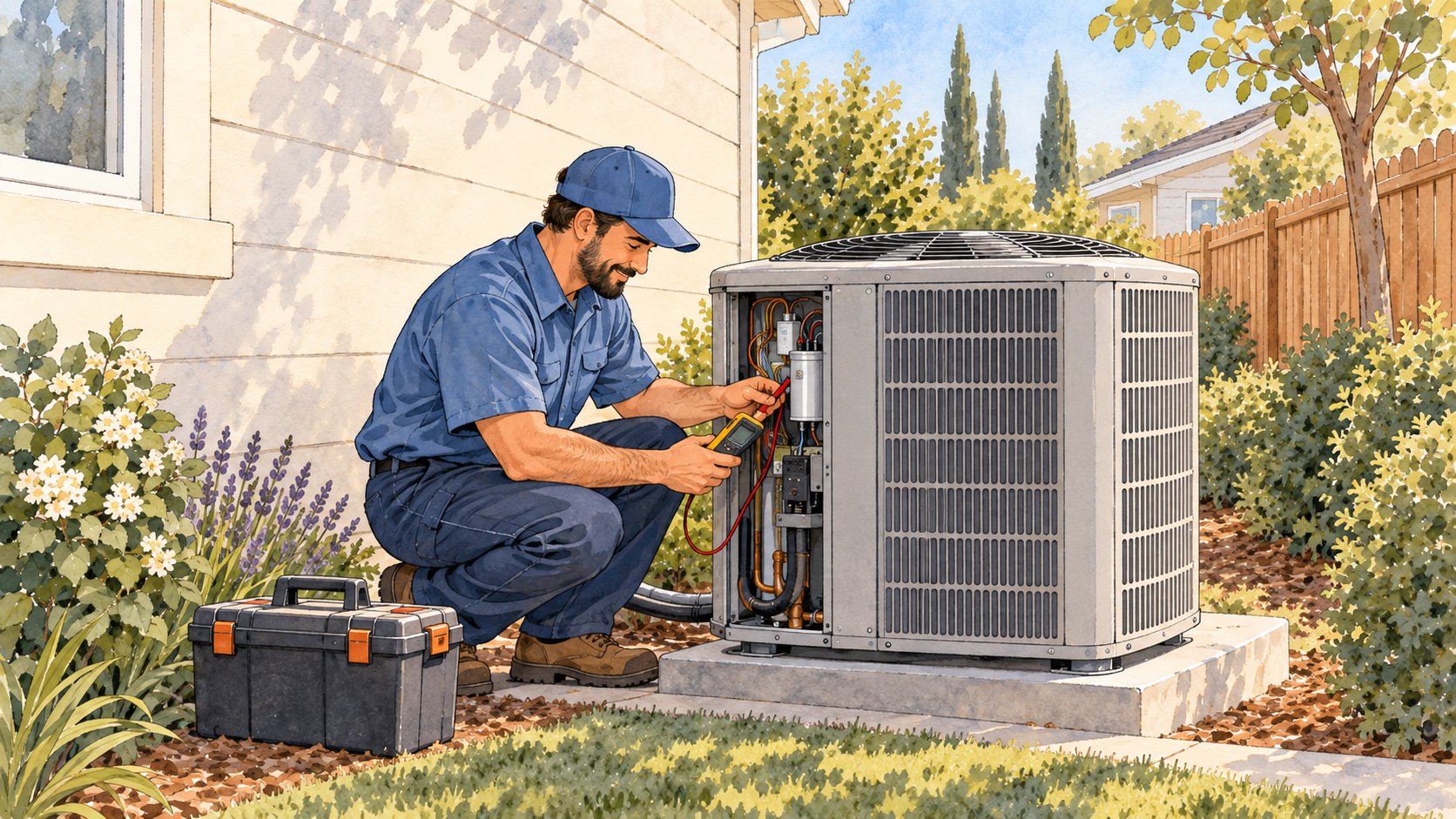
When a licensed technician shows up for a fan that won’t turn, the visit shouldn’t be a guess. They kill power at the disconnect, discharge the capacitor safely, and test it against its stamped microfarad rating. Reading well under means you’ve found your answer.
Then they check the contactor for pitting, measure incoming voltage, and read the fan motor’s amp draw against the nameplate. A motor pulling too many amps is on its way out even if it’s turning today.
The last step separates a good technician from a parts changer: finding out why the part failed. A capacitor that died at three years old usually died because the motor is straining, or the coil is packed with cottonwood fluff and the unit runs hot. Skip the cause and you’ll make the same call next July, which is a big part of why regular AC maintenance pays for itself here.
Common mistakes we see
The costliest one is leaving the thermostat on while you troubleshoot. A homeowner off Elk Grove Florin Road called us last summer after the unit had been humming since breakfast. The fan motor quit around nine, and by afternoon the compressor had spent most of the day pumping into a coil that couldn’t reject heat. The conversation stopped being about a fan motor.
Second is repeatedly resetting a tripped breaker. A shorted motor winding will keep tripping it, and each reset dumps current into a fault.
Third is ordering a capacitor online and swapping it yourself. Capacitance and voltage both have to match, the wiring has to go back exactly right, and a botched swap can void warranty coverage you still have.
Fourth is assuming a fan that starts back up on its own means the problem fixed itself. A thermal overload resetting is a symptom, not a repair. It’ll trip again, usually on the hottest day of the year.
What to do right now
Set the thermostat to off and leave it off. Give the outdoor unit thirty minutes to cool before anyone works near it. Check the breaker panel and the outdoor disconnect, look for anything stuck in the blade, and pull your air filter to see whether you can read a newspaper through it.
Then call a licensed pro. If your house is climbing past 85 and you’ve got young kids, someone elderly, or pets at home, treat it as urgent and ask about emergency AC repair rather than waiting for a routine slot. Meanwhile, close the blinds on the sun side and run ceiling fans.
Past those basics, AC repair on a system with a stopped fan isn’t a weekend project. The electrical side of a condenser is where people get hurt.
Key takeaways
An AC fan not spinning is most often a failed run capacitor, and a hum with no blade movement is the clearest tell you’ll get.
Turning the thermostat off protects your compressor while you sort out the rest, which makes it the most valuable thing you can do.
Check the thermostat, breaker, disconnect, filter, and visible debris yourself. Everything past that belongs to someone with a meter and a license.
A repair that doesn’t answer why the part failed isn’t finished. Ask what caused it, not just what got replaced.
Questions we get a lot
Can I run my AC if only the outdoor fan is out?
No. The indoor blower keeps moving air and the house feels okay for a while, which is exactly what fools people. Without the condenser fan, heat has nowhere to go and the compressor is at risk every minute the system runs.
Will maintenance actually prevent this?
Not every failure, but it catches the ones that give warning. Capacitance drifting low, a contactor pitting, and a motor pulling high amps all show up on a proper tune up before they leave you sweating on a Saturday. Our AC tune up checklist covers what a real service visit should include.
My fan spins but the air is warm. Same problem?
Usually not. If the blade is turning, look at refrigerant charge, the compressor, or airflow. Our guides on failing compressors and unusual AC noises are better starting points.
Is it worth repairing a fan motor on an old system?
Depends on age and history. A motor on a twelve year old unit that’s already needed a couple of repairs may be money better put toward a replacement. The U.S. Department of Energy has useful general guidance on central air conditioning if you’re weighing that.
A quick note about us
Elk Grove AC Pros is a local HVAC information and lead request service. We’re not a licensed contractor, and this article is general information rather than professional HVAC advice. Every house is different, so a licensed local pro should assess your specific system before you spend money on parts or repairs.
If your fan has stopped and you’d rather not guess, request a free quote and we’ll connect you with a licensed local pro serving Elk Grove and the greater Sacramento area. No pressure, and no charge to ask.