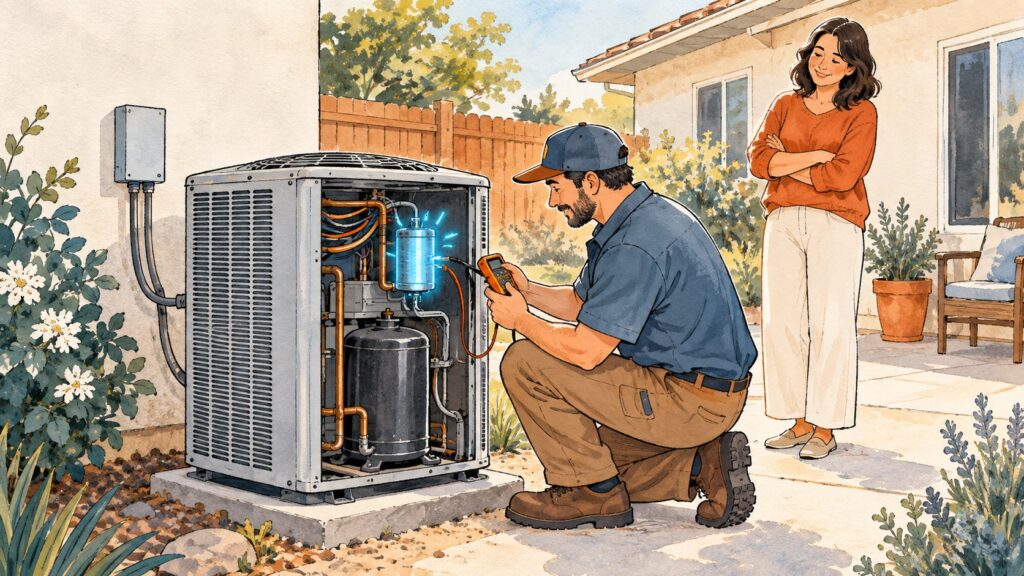
It’s the middle of a July afternoon in Elk Grove, the thermostat reads 78, and the house feels closer to 85. You walk out to the side yard and the condenser is doing something odd. There’s a low hum, but the big fan on top isn’t turning.
You wait a few minutes. Still humming, still not spinning. That combination, a unit that sounds alive but never actually starts, usually points at a part about the size of a soup can sitting behind the service panel.
Capacitors are the most replaced part in residential air conditioning, and a Sacramento Valley summer is about the hardest place you can put one. Here’s what it does, how to spot one going out, and why our heat wears them down.

What Your AC Capacitor Actually Does
Your outdoor unit has two motors that need a hard shove to get moving: the compressor and the condenser fan. Ordinary household power on its own doesn’t give them enough of a push.
The capacitor stores a burst of electrical energy and dumps it into those motors at the moment they start. Then it keeps feeding them a steady electrical nudge the entire time they run. It’s part crank, part flywheel.
Most systems built in the last couple of decades use a dual run capacitor, which is one cylinder serving both the compressor and the fan. That’s why a single failed part can shut down your whole cooling system at once.
Some systems also carry a separate start capacitor that engages for a second or two and drops out. The run capacitor gets no such break. It’s energized every minute your AC is on, which is a big part of why it wears out.
Why AC Capacitor Failure Is So Common Around Elk Grove
Heat is the main culprit. A capacitor is a sealed can of thin foil and chemical film, and the hotter that material gets, the faster it degrades.
Now picture where yours lives. It’s bolted inside a metal cabinet, in a side yard, in direct afternoon sun, on a day when the outside air is already past 100. The inside of that cabinet runs considerably hotter than the air around it.
Manufacturers generally expect these parts to last five to ten years, and that assumes a mild climate. In a valley that spends most of June through September in the 90s and above, plenty of homeowners land near the short end.
Two other things stack on top of the heat. Voltage sags and surges during heat waves stress the part, and a system that’s already straining for another reason, like a filthy condenser coil or a restricted filter, pulls more current through the capacitor on every cycle.
So a neglected system isn’t just running less efficiently. It’s quietly shortening the life of the cheapest part in the box, which is one reason a yearly tune up and regular AC maintenance pay for themselves.

Six Signs Your Capacitor Is Going Out
1. A hum outside with nothing spinning
This is the classic one. The system calls for cooling, the outdoor unit energizes and hums, but the fan sits still and the compressor never catches.
That hum is a motor trying and failing to start. Leaving it humming for long can cook the motor windings, so shut the system off at the thermostat if you hear it.
2. Hard starting
A weak capacitor often still works, just barely. The unit takes several seconds longer than it used to before the fan gets going, or it groans on start and then settles.
Most people write that off as the system getting old. It’s usually the earliest warning you get, and catching it in May is a lot easier than catching it in August.
3. Warm air from the vents while the indoor fan runs
If air is moving through your registers but it’s room temperature, the indoor blower is fine and the outdoor unit isn’t doing its job. A dead capacitor is one of the most common reasons for that split.
It isn’t the only reason, though. Our guide to an AC that won’t blow cold air covers the rest.
4. Short cycling
The system starts, runs for a couple of minutes, shuts off, then tries again. A capacitor that can’t hold its charge lets the motor start and then stall out repeatedly.
5. Clicking, then silence
You hear the contactor click when the thermostat calls, and then nothing follows. The signal is getting to the unit, but the motors never turn over.
6. A bill that climbs for no obvious reason
A struggling motor draws more electricity than a healthy one. If nothing about your habits changed and the summer bill jumped anyway, a weak capacitor is worth ruling out.
New noise deserves attention too, since a buzzing or rattling unit can mean several things. See our piece on why an AC starts rattling.
What a Technician Actually Checks
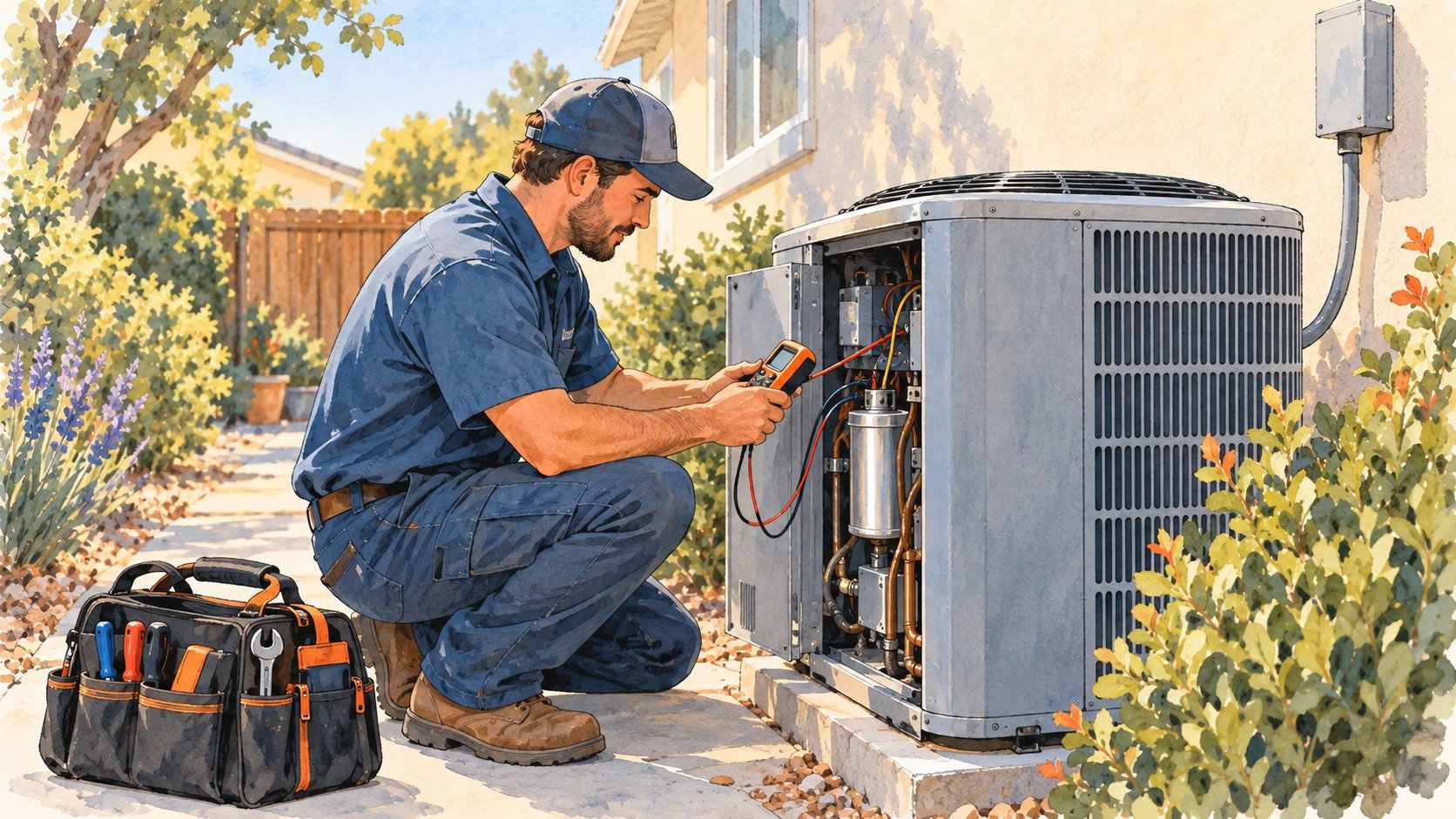
A proper diagnosis takes more than looking at the part. Every capacitor is stamped with a rating in microfarads, and a technician measures the real capacitance with a meter and compares it to that number.
A part reading well below its rating is failing even if it still runs the system. A bulged top or an oily film on the can tells the same story.
Then comes the part that matters more: figuring out why it died. A good tech checks the contactor for pitting, measures the amp draw on both motors, and looks at the condition of the coil and the airflow.
A capacitor that fails twice in two seasons is a symptom, not the problem. Something is making those motors work too hard, and swapping the part again without finding it just buys a few months. Our AC repair page explains what a real diagnostic visit covers.

Why This Isn’t a Part to Swap Yourself
Capacitors look simple. They’re cheap, easy to find online, and there’s no shortage of videos showing the swap. Here’s the problem.
A capacitor can hold a dangerous charge long after the power is off. Cutting the breaker does not drain it. Technicians discharge the part deliberately before touching a terminal, and careless contact across those terminals can put a serious jolt through you.
Matching is the second issue. Capacitors carry a microfarad value and a voltage rating, and dual capacitors hold two values in one can. Something close but not correct makes the compressor run rough, and the compressor is the expensive part.
Then there’s your warranty. Many manufacturers void coverage on parts touched by an unlicensed person, so a cheap part can cost you a compressor claim later. The Department of Energy’s central air conditioning guidance makes the same point about qualified pros.

Common Mistakes That Kill Capacitors Early
Resetting the breaker over and over. If the system trips, keeps humming, or won’t start, flipping the breaker back repeatedly forces the motor to keep straining. Turn it off and leave it off until someone looks at it.
Letting the outdoor unit get crowded. Shrubs, fence boards, and stacked yard waste against the cabinet trap heat right where the capacitor lives. Most manufacturers want a couple of feet of clear space on every side and open air above.
Skipping the filter. A clogged filter starves the system for air, which makes everything downstream work harder and run hotter. Most one inch filters want changing every 30 to 90 days, and homes with pets or a smoky summer land at the short end.
Assuming a hum means the compressor is dead. Plenty of homeowners get quoted a full system replacement for what turns out to be a part costing a fraction of that. Get the diagnosis in writing, and get a second opinion before replacing a system.
A family off Elk Grove Florin Road called last summer convinced their eight year old system was finished. It hummed, it never started, and a salesperson had already handed them a replacement quote. The real problem was a capacitor swollen shut in a cabinet baking against a west facing fence.
What to Do Right Now
If your outdoor unit is humming without starting, turn the system off at the thermostat first. That protects the motors while you wait.
Don’t open the electrical panel on the condenser, and don’t reach in to spin the fan blade. Both put you next to stored voltage and a blade that can start without warning.
Then get it looked at. During a valley heat wave this is worth treating as an emergency AC repair rather than something that waits.
Key Takeaways
- The capacitor gives your compressor and condenser fan the electrical push they need to start and keep running.
- Heat is what kills them, so valley summers pull real life below the five to ten year range most people expect.
- A hum with no start, hard starting, warm air at the vents, short cycling, clicking, and a climbing bill are the signs worth acting on.
- Replacing the part without finding why it failed usually means doing it again soon.
- Stored charge and matched ratings make this a job for a licensed pro.
Frequently Asked Questions
Can I keep running my AC with a weak capacitor?
It’s a bad idea. Every strained start pushes extra current through the compressor, and trading a small repair for a compressor failure is a poor deal.
How long does a replacement take?
The swap itself is quick once the tech has the right part on the truck. The diagnosis, and the check for what caused the AC capacitor failure in the first place, make up most of the visit.
Does a bad capacitor mean my compressor is bad too?
Not usually. A failed capacitor on its own is a routine repair. But a compressor fed by a weak capacitor for a long stretch can be damaged, which is why the two get checked together. Our guide to a failing AC compressor covers what that looks like.
Getting Help in Elk Grove
AC capacitor failure is one of those problems that’s both extremely common and usually straightforward, as long as somebody checks what caused it. Catching that first slow start is what separates a short visit from a July afternoon with no cooling at all.
Elk Grove AC Pros is a local HVAC information and lead request service, not a licensed contractor. This article is general information and not professional HVAC advice. Every system and home is different, so a licensed local pro should assess yours before any repair.
If your outdoor unit is humming, starting slowly, or blowing warm air, request a free, no pressure quote and we’ll connect you with a licensed local pro serving Elk Grove and the greater Sacramento area.