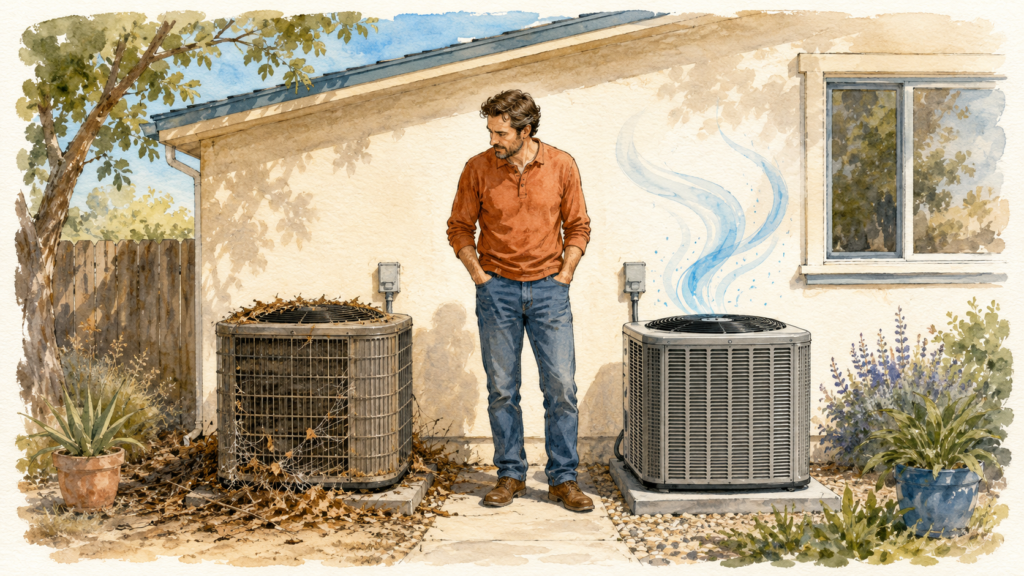
The AC was fine last summer. That’s the sentence we hear most in August, usually from somebody standing in a 95 degree living room while the unit outside hums along doing nothing useful.
Nothing broke overnight, though. Something drifted for two or three summers and nobody looked.
That slow drift is what skipping AC maintenance really costs you, and it never arrives as one big bill. It shows up as a fatter SMUD statement in July, a repair that used to be a cleaning, and a system that quits at twelve years instead of eighteen. Around Elk Grove, where your AC runs hard from May into late September, that math moves faster than it does almost anywhere else in the country.
What happens to an AC that nobody touches
Your AC doesn’t fail the way a light bulb fails. It degrades, quietly, on a schedule you never see.
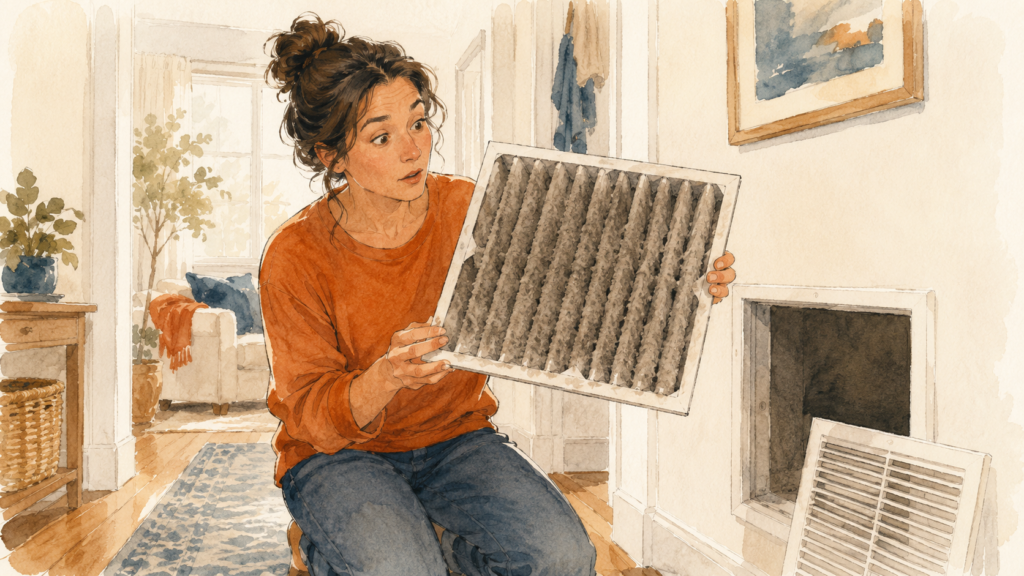
It starts with the filter. Sacramento Valley air carries a lot of dust, grass pollen, and summer grit, and all of it ends up in the filter media. As that filter loads up, airflow across the indoor coil drops. Less air over the coil means the coil gets colder than it should, the system takes longer to satisfy the thermostat, and every part downstream works harder for the same result.
Outside, the condenser coil collects its own layer of dust, cottonwood fluff, and lawn clippings. That coil’s entire job is dumping your home’s heat into the air. When a felt of debris covers it, it can’t let go of that heat, pressure climbs, and the compressor runs hotter than it was designed to run.
Meanwhile the condensate drain grows a slime of algae, the capacitor loses its punch, and the blower wheel picks up a coat of dust that throws it slightly out of balance.
None of this announces itself. The house still cools. It just costs more every year to get there.
What skipping AC maintenance does to your power bill
The first real cost lands on your power bill, and it’s the one homeowners misread most often.
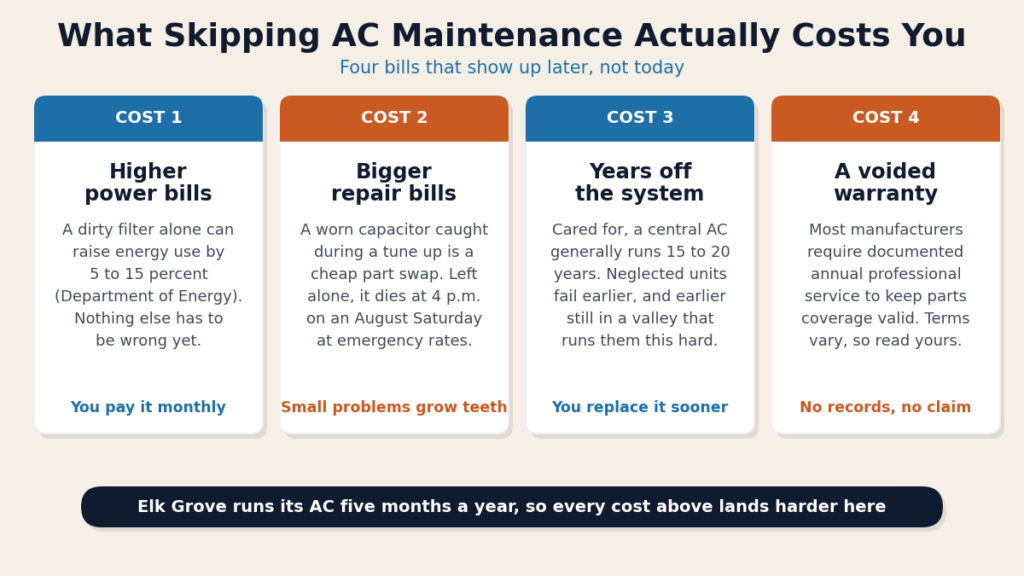
The Department of Energy is blunt about the filter alone: cleaning or replacing a dirty filter can lower an air conditioner’s energy use by 5 to 15 percent. That’s one part, on one system, doing one job badly. Add a dirty condenser coil and a charge that’s drifted off spec and the gap widens further.
Here’s why it sneaks past people. A struggling AC doesn’t blow warm air at first. It just runs longer to hit the same 76 degrees, and longer runtime in July is invisible until the statement arrives. Most folks blame the heat wave, not the machine. We wrote more about that in our piece on why SMUD bills spike in July, because the two get confused constantly.
Elk Grove makes this expensive in a way that coastal homeowners never feel. A house in the Bay Area runs its AC maybe thirty afternoons a year. Yours runs most of five months. A ten percent efficiency penalty across thirty days is a rounding error. The same penalty across a full valley summer is real money, every year, for as long as you own the house.

Small problems that grow teeth
The second cost is repairs, and this is where skipping AC maintenance stops being an abstraction.
Take the capacitor. It’s a small cylinder that gives the compressor and fan motor the jolt they need to start. Heat kills capacitors, and a condenser choked with debris runs hot, so a neglected unit cooks its own capacitor early. Caught during a tune up, it’s a cheap part swapped in ten minutes. Ignored until it dies at 4 p.m. on a Saturday in August, it’s an emergency call, and the compressor may have spent weeks straining against a weak start.
The pattern repeats across the whole system. A clogged condensate drain is a five minute flush during service and a ceiling stain three months later. A dirty evaporator coil is a cleaning today and a frozen coil next month, which can slug liquid refrigerant back into a compressor that costs more than most of the rest of the system combined. Our guide to AC coil cleaning walks through why that one part causes so much trouble.
Not every expensive repair starts this way. But most of them do.
The years you quietly give away
Central air conditioners generally last somewhere in the range of 15 to 20 years when they’re looked after. That range assumes normal wear and a system that isn’t fighting itself.
A neglected unit isn’t running under normal wear. Its compressor works against high head pressure every hot afternoon, its motors run hot, its parts cycle harder to deliver the same cooling. Systems that get ignored routinely fail years earlier than their maintained neighbors, and here in the valley they fail earlier still, because our season is long and brutal.
Think about what those lost years are actually worth. If a system that could have run eighteen summers gives up after twelve, you didn’t save the cost of a dozen service visits. You bought a whole AC replacement six years early, and you almost certainly bought it in the middle of a heat wave, when nobody negotiates well.
The warranty problem most homeowners never read about
Most manufacturers write annual professional maintenance into the terms of their parts warranty. Not a suggestion. A condition. If a compressor fails in year seven and you can’t produce service records, a manufacturer can deny the claim, and you pay for a part that was technically still covered.
Terms vary a lot by brand and by when the system was installed, so don’t take our word for what yours says. Dig out your paperwork and read the maintenance clause. If you can’t find it, the model number on the outdoor unit is usually enough for the manufacturer’s support page to tell you.
Common mistakes we see around Elk Grove
Some of these are habits. Some are well meant efforts that backfire.
- Only calling when it breaks. By then you’re paying emergency rates in the worst week of the year, along with everybody else in the neighborhood.
- Changing the filter once a year. A filter that looks fine in March is loaded by July. Check it monthly during the season.
- Letting landscaping crowd the unit. We see condensers hemmed in by oleander and jasmine, sometimes with three inches of clearance. That unit needs to breathe.
- Assuming a new system is exempt. A three year old AC still cakes its coils in valley dust, and it’s the years you skip early that void the warranty later.
- Pressure washing the condenser. Good instinct, wrong tool. Those aluminum fins bend under real pressure and bent fins block the airflow you were trying to improve. A garden hose from the inside out, with the power off, is the move.

What to do if you’ve already skipped a few years
Nobody’s grading you. Plenty of Elk Grove homes go five or six summers without a service call. Start where you are.
Put a fresh filter in today. It’s the cheapest thing on this list and the one with the fastest payback.
Then clear two feet of open space around the outdoor unit. Pull the weeds, cut the shrubs back, move the recycling bin.
Then book a real AC maintenance visit and ask for the readings. A genuine tune up isn’t a technician glancing at the unit and handing you an invoice. It’s coil cleaning, a refrigerant charge check, an electrical inspection, a drain flush, and actual numbers you can compare next year. Our AC tune up checklist shows what should be on that list.
After that, get on a rhythm. For most homes here that means once a year, in spring, before the first stretch of triple digits. Some systems want more. How often you should service your AC breaks down which is which.
Key takeaways
- Neglect doesn’t break your AC. It slowly makes the same cooling cost more, and you don’t notice until July.
- A dirty filter alone can push energy use up by 5 to 15 percent according to the Department of Energy, and it’s rarely the only thing that’s dirty.
- Most large repairs start as small ones a technician would have caught during a routine visit.
- Skipped years come off the back end of your system’s life, and replacing an AC six years early costs far more than the visits you skipped.
- Your parts warranty probably requires documented annual service. Check your paperwork.
- Elk Grove’s long season makes every one of these costs bigger than it would be in a milder climate.
Questions we get asked
Is a yearly tune up really worth it if my AC seems fine?
That’s exactly when it’s worth it. A system that seems fine can still be running ten percent inefficient with a weakening capacitor, and the visit that catches both is the cheap version of the story. Once your AC stops seeming fine, you’re buying a repair, not maintenance.
My AC is twenty years old. Is maintenance just throwing money at it?
The calculation changes, but no. On a system that old, a service visit is partly diagnosis: it tells you whether you’ve got two good summers left or two rough weeks. And if a technician finds a failing compressor, knowing that in April beats finding out in August.
Can I just do the maintenance myself?
A meaningful chunk of it, yes. Filters, clearing debris, and a gentle hose rinse of the condenser with the power off are all reasonable homeowner jobs. What you can’t do is check refrigerant charge, test electrical components under load, or clean an indoor coil properly, and that’s where the expensive failures hide.
The bottom of it
Skipping AC maintenance isn’t a character flaw and we’re not going to lecture you about it. It’s a trade. You spend a little on a predictable schedule so you don’t spend a lot on an unpredictable one, in the week when every HVAC company in Sacramento County is booked solid.
That trade just happens to be lopsided in your favor here, because Elk Grove asks more of an air conditioner than most places do.
Elk Grove AC Pros is a local HVAC information and lead request service. We’re not a licensed contractor, and this article is general information rather than professional HVAC advice. Every system and every home is different, so a licensed local pro should assess your specific equipment before you make a decision about it.
If it’s been a few summers, we can connect you with a local pro for a free, no pressure quote on a maintenance visit. Tell us what your system’s doing and we’ll take it from there.