
Two contractors stand in your driveway, and each hands you a quote. One recommends a 14.3 SEER2 system. The other pushes a 20 SEER2 unit that costs a good bit more. They’re looking at the same house, so how can the right answer be so far apart? If you’ve ever stared at those numbers and felt like you were being sold something, you’re in good company.
Here in Elk Grove, where the AC runs hard from May well into September, that efficiency number really does shape your summer bills. But bigger isn’t automatically better, and the highest rating on the sheet isn’t always the smartest buy for a Sacramento Valley home.
So let’s sort it out. By the time you finish reading, you’ll know what a SEER rating measures, what the law requires around here, and the range that fits most homes in our area.

What a SEER rating actually measures
SEER stands for Seasonal Energy Efficiency Ratio. Think of it like miles per gallon, but for cooling. It tells you how much cooling a system delivers for the electricity it burns across a whole cooling season.
A higher number means the unit squeezes more cool air out of every dollar of power. A 16 SEER2 system uses noticeably less electricity to cool the same house than an old 10 SEER clunker from the early 2000s.
The key word is seasonal. The rating is an average across a range of temperatures, not a promise for one brutal 104 degree afternoon. That distinction matters more than most homeowners realize, and we’ll circle back to it.
SEER2 changed the numbers you’ll see
If you shopped for AC even a few years ago, you might remember plain SEER numbers like 14 or 16. Starting in 2023, the federal government switched to a tougher test called SEER2. The new test measures units under more realistic conditions, closer to a real duct system in a real house.
Because the test is harder to pass, SEER2 numbers run a little lower than the old SEER numbers for the same equipment, usually by around four to five percent. So a unit that once would have been labeled 15 SEER might now read about 14.3 SEER2.
Nothing got worse about the machines. The yardstick just got stricter. When you compare quotes today, make sure you’re comparing SEER2 to SEER2, not an old rating against a new one. You can read more about the official federal standards at the Department of Energy.
What SEER rating do you need in Elk Grove?
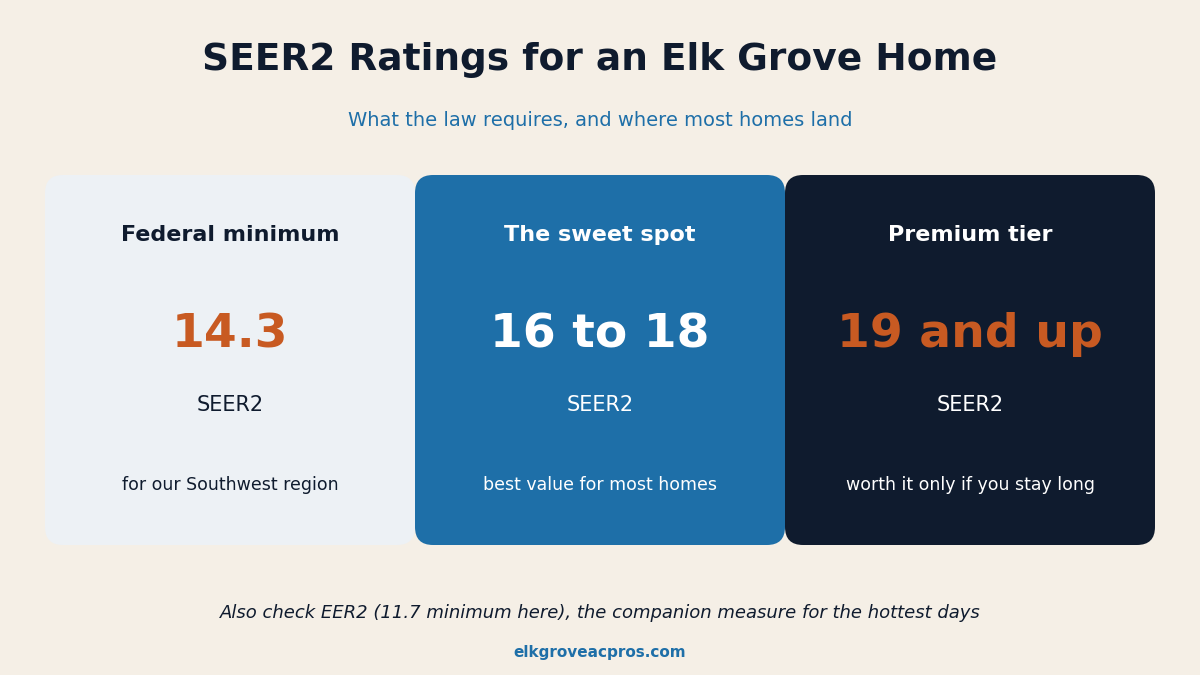
Elk Grove sits in what the Department of Energy calls the Southwest region, where summers are long and hot, so the law sets a higher floor here than in cooler parts of the country. For a new split system central air conditioner, the current federal minimum in our region is 14.3 SEER2 for most home sized units, along with a companion measure called EER2 that tracks performance on the hottest days.
That minimum is the floor, not the target. For a home in the Sacramento Valley that runs its AC five or six months a year, most homeowners land in a sweet spot of roughly 16 to 18 SEER2. That range buys real efficiency without the steep price jump of the top tier units.
Could you go higher? Sure. But whether the extra efficiency pays off depends on your house, your ducts, and how long you plan to stay. When you’re ready to talk through the right size and rating for your home, our team can walk you through it during an AC installation visit.

Why a higher SEER rating isn’t always worth it
It’s tempting to just buy the biggest number on the sheet. More efficiency sounds like more savings. But the math has a curve to it.
The jump from a 14 SEER2 unit to a 16 or 18 SEER2 unit brings a solid drop in energy use. The jump from 18 up to 22 brings a smaller improvement for a much bigger price tag. Somewhere in the middle, you stop saving enough on your bill to make the pricier unit pay for itself before it wears out.
The best rating for you is the one that pays you back within a reasonable stretch of years, not the one with the flashiest label. A very high efficiency system can still be a smart choice if you plan to stay in your home a long time, run your AC almost nonstop, or want the quietest, most even cooling money can buy. For a family that expects to move in a few years, a mid range unit usually makes more sense.

The mistakes that cost more than a low SEER number
Here’s what a lot of homeowners miss. A high SEER rating on a poorly installed system will lose to a modest unit that was installed right. The number on the box is a lab result. Your real comfort comes down to a few things that have nothing to do with SEER.
Sizing is the big one. An AC that’s too large for your home short cycles, flipping on and off too fast, which wastes power and leaves rooms humid and uneven. One that’s too small runs forever on hot days and still can’t keep up. A good contractor runs a proper load calculation instead of eyeballing it.
Ductwork matters just as much. Leaky or undersized ducts can throw away a big share of the cool air you paid for before it ever reaches your rooms. If your ducts are in rough shape, sealing them often does more for comfort than chasing a higher SEER number.
Refrigerant charge and airflow round out the list. Even a top tier unit loses efficiency if it’s overcharged, undercharged, or starved for airflow. This is why install quality decides how your system actually performs. If an older system is limping along, our guide on whether to repair or replace an aging AC can help you think it through, and a solid AC repair visit can tell you where you stand.
Key takeaways
- SEER measures cooling efficiency across a whole season, a bit like miles per gallon for your AC.
- Since 2023, ratings use the stricter SEER2 test, so numbers read a little lower than the old SEER scale.
- Elk Grove’s federal minimum for a new split system is 14.3 SEER2, but most homes here do well in the 16 to 18 SEER2 range.
- Higher isn’t always better. Above the mid range, savings shrink while the price keeps climbing.
- Correct sizing, sealed ducts, and a clean install matter more than squeezing out the last point of SEER.
If trimming your summer power use is the real goal, our rundown of energy efficient AC options for Sacramento Valley homes pairs nicely with this one.
Frequently asked questions
Is a 14.3 SEER2 unit good enough for Elk Grove?
It meets the law and it will cool your home. For our long, hot summers, though, stepping up to the 16 to 18 SEER2 range usually trims your bills enough to be worth the modest difference over the life of the system.
Will a higher SEER rating lower my SMUD bill?
A more efficient unit uses less electricity to do the same cooling, so yes, it can help. Just remember your thermostat habits, your insulation, and your ductwork all shape the final number too.
How do I compare two quotes with different SEER numbers?
Make sure both are quoted in SEER2, then weigh the price difference against how long you plan to stay and how much you run the AC. Ask each contractor how they sized the unit, not just what rating they picked.
Talk to a local pro before you buy
A quick note before you go. Elk Grove AC Pros is a local HVAC information and lead request service, not a licensed contractor. This article is general information, not professional HVAC advice, and the exact SEER rating, size, and setup that fit your home should be assessed by a licensed local pro who can see your system in person. Efficiency standards and rebate details change, so confirm the current numbers before you buy.
If you’re weighing a new system for your Elk Grove home, we’re happy to help you make sense of it. Request a free, no pressure quote through our contact page and we’ll match you with a trusted local pro who knows Sacramento Valley summers.