Line up three new AC units in a showroom and they look like the same beige box with a fan on top. The thing separating the cheap one from the one that costs twice as much is a sticker covered in numbers most people have never seen before.
We hear the same story every summer from homeowners around Elk Grove. Three quotes, three different efficiency levels pushed, nobody explaining why. So they picked on price. Two Julys later they’re staring at an SMUD bill wondering what they missed.
Efficiency ratings matter more here than in most of the country, because of the specific way our summers behave. But the biggest number on the wall isn’t automatically the right buy. Choosing an energy efficient AC in the Sacramento Valley comes down to three things, and only one of them is the sticker.
Two numbers, not one
Most people have heard of SEER. On January 1, 2023, the federal government replaced it with SEER2, the same basic idea measured under a tougher test. The old test ran equipment against almost no resistance, like a system connected to perfect ductwork that doesn’t exist in any real house. The newer M1 test raises that resistance five times over to reflect what actual ducts do to airflow.
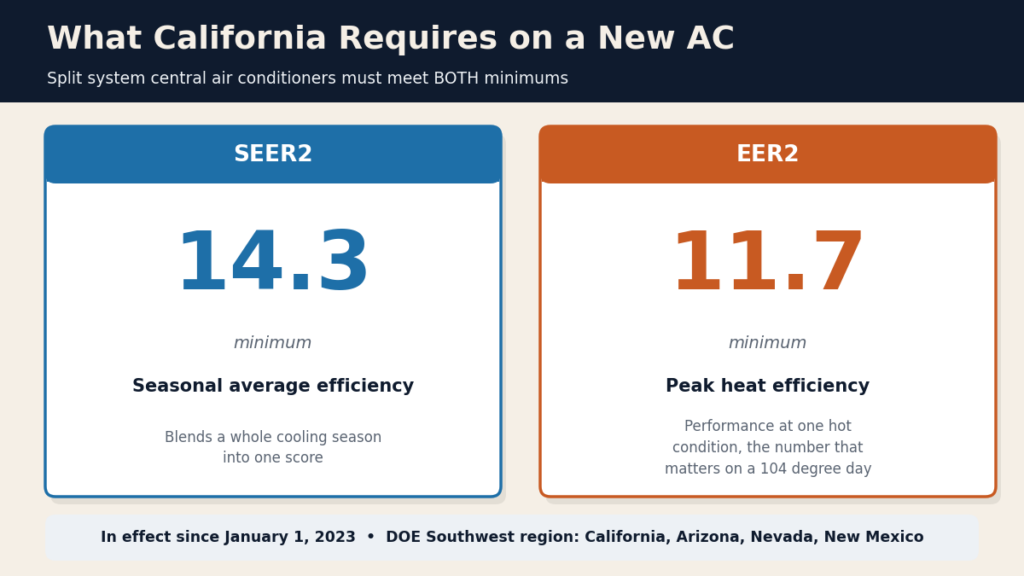
SEER2 is a seasonal average. It blends mild days and brutal days into one score, which makes it useful for comparing units and useless for predicting a specific afternoon.
Then there’s EER2, the one nobody mentions in the sales pitch. It measures performance at a single hot condition instead of averaging a whole season, answering a narrower question: when it’s genuinely miserable outside, how hard does this thing have to work?
Why California treats AC differently
The Department of Energy splits the country into regions, and California sits in the Southwest alongside Arizona, Nevada, and New Mexico. That grouping isn’t arbitrary. It’s built around hot dry climates where the afternoon peak is the whole problem.
Because of that, a split system central AC installed in California has to clear two minimums, not one: 14.3 SEER2 and 11.7 EER2. Most of the country only has to satisfy the seasonal number. We have to satisfy the peak number too.
That second requirement exists for a reason you already know if you’ve spent a July here. Our heat isn’t spread evenly. A 104 degree afternoon does more damage to your comfort and your bill than a whole week of 88 degree mornings, and it lands right when SMUD’s rates are least forgiving. A system with a good seasonal score but a weak peak score feels fine in June and struggles when you need it most.
So when a contractor quotes a SEER2 number and stops, ask for the EER2 number too. In this valley it tells you more.

The compressor is where efficiency actually lives
Ratings are the report card. The compressor is the student.
A single stage compressor has one setting: full blast. It slams on, drives the house cold, shuts off, waits. Cheapest to buy, and it’s why some rooms swing warm while others get chilly.
A two stage compressor has a low setting and a high setting. It spends most of its life on low, which covers a normal Elk Grove afternoon, and saves the high setting for real heat. Longer, gentler cycles. Fewer temperature swings.
A variable speed compressor throttles across a whole range, more like a dimmer than a light switch. It’ll idle at a fraction of its capacity for hours. The high SEER2 numbers you see advertised are almost always variable speed systems, because running slow and steady beats sprinting and stopping.
There’s a comfort benefit that never shows up on the sticker. Longer run times mean the air passes over the coil more often, which pulls more moisture out. That matters less here than in Florida, but you notice it on the muggy days after a thunderstorm rolls through the valley.

Should you be looking at a heat pump instead?
A heat pump is an air conditioner that can run backward.
In summer it does exactly what your AC does now, pulling heat out of your house and dumping it outside. In winter it reverses and pulls warmth from the outdoor air into your home instead. Same box, two seasons.
For a lot of Sacramento area homes this fits better than people expect, because our winters are mild. Heat pumps lose efficiency as outdoor temperatures drop toward freezing, which is a real problem in Minnesota and mostly a theoretical one here. Replacing an aging AC and a furnace within a few years of each other? Ask your contractor to price a heat pump as one of the options.
Heat pumps also tend to be where the federal tax credits and utility rebates are aimed. Those programs change often, so treat any number a salesperson quotes as something to verify yourself. Our guide to HVAC rebates and tax credits in California walks through where to look.
How to choose an energy efficient AC in the Sacramento Valley
The honest answer is that the right energy efficient AC for a Sacramento Valley home depends on how long you’re staying and how hard you run it.
The math is simple in shape even if the numbers are personal. A more efficient system costs more up front and returns that money slowly through lower bills. Plan on fifteen more years in the house with the AC running hard from May through September, and there’s plenty of runway for those savings to add up. List the place in two years and you’re mostly buying a selling point.
Three questions that cut through most of the sales noise:
- What’s the EER2, not just the SEER2? A contractor who knows our climate will have that answer ready.
- What kind of compressor is in it? Single stage, two stage, or variable speed tells you more about how the house will feel than the rating does.
- Did you measure my house, or my old unit? This one matters more than everything else on the list, and it’s the next section.

The part that quietly ruins good equipment
You can buy the most efficient system on the market and still get mediocre results. It happens constantly.
That efficiency rating was earned in a lab, connected to ductwork sized correctly and sealed properly. If your ducts leak into the attic, or they’re undersized, or they got crushed sometime in the last thirty years, your new system spends its life fighting the house. The SEER2 test exists specifically because real ducts choke airflow. Bad ducts choke it far worse than the test assumes.
Sizing is the other silent killer. An oversized system cools the air fast, hits the thermostat setting, and shuts off before it’s done real work. Short cycles, uneven rooms, a compressor that wears out early. Bigger is not better with AC, and a variable speed system that’s badly oversized loses most of the advantage you paid for.
A careful load calculation and honest duct work do more for your comfort than jumping two efficiency tiers. Quality AC installation starts there, not with a model number.
Common mistakes we see
Buying the top tier because it’s the top tier. Going from a basic system to a solid mid range one usually returns real money. Going from mid range to the flagship returns much less and takes far longer to pay back.
Comparing quotes on price alone. A low bid that skips the load calculation and reuses questionable ducts isn’t a deal. It’s the same system performing worse.
Assuming the new unit fixes an old problem. If one room was always hot before, a more efficient box outside won’t change that. The cause is usually airflow, and it follows you to the new system.
Skipping maintenance afterward. A dirty coil drags down a high efficiency system just like a cheap one. Efficiency decays. Our piece on what skipping AC maintenance really costs gets into it.
Key takeaways
- SEER2 replaced SEER on January 1, 2023, using a tougher test that accounts for real ductwork resistance.
- California sits in the DOE’s Southwest region, so a new split system AC here must hit 14.3 SEER2 and 11.7 EER2. EER2 is the peak heat number, and it’s the one that matters on a 104 degree afternoon.
- Compressor type, single stage versus two stage versus variable speed, drives both the rating and how the house feels.
- Heat pumps deserve a look here because our winters are mild, and that’s where the incentives point.
- Duct condition and correct sizing make or break the efficiency you paid for.
Questions we hear a lot
Is a higher SEER2 always worth the extra cost?
No. It depends on how long you’ll own the home and how hard you run the system. The savings are real but they arrive slowly, so a long stay and heavy summer use make the upgrade much easier to justify.
Can I install a cheaper unit from out of state?
Not legally. The Southwest standards govern what gets installed here, not just what gets manufactured. A unit that’s fine in Oregon can’t go in a California home if it misses either minimum. The DOE’s regional standards guidance is at energy.gov.
Will a new efficient system cut my SMUD bill in half?
Be skeptical of anyone promising a specific percentage. Savings depend on what you’re replacing, your ducts, your insulation, your thermostat habits, and your rate plan. Real improvement is common. Guaranteed numbers are a sales tactic.
What if my AC still works but it’s old?
Working and worth keeping aren’t the same thing. If it’s limping along and eating repairs, run the numbers. Our repair or replace guide lays out how.
Getting a straight answer for your home
Nobody can name the right efficiency level for your house from a blog post. It depends on your ducts, your insulation, your windows, and how many more summers you plan to spend there. That takes someone in your attic with a tape measure.
What you can do is walk into that conversation knowing what SEER2 and EER2 mean, why California asks for both, and why the contractor who measures your house beats the one quoting the biggest number.
Elk Grove AC Pros is a local HVAC information and lead request service. We are not a licensed contractor, and this article is general information, not professional HVAC advice. Efficiency standards, rebate programs, and tax credits change, so verify any figure before you rely on it. A licensed local pro should assess your specific system and home.
Want a second opinion on a quote you’ve already got? Request a free, no pressure quote and we’ll connect you with a local pro serving Elk Grove and the greater Sacramento area.