
The first warm Saturday in March fools everybody. It’s 78 out, the windows have been open all week, and you flip the thermostat over to cool just to hear the system kick on. Air comes out. Feels fine. You go back to the yard and forget about it until June.
That quick test is where most of us stop, and it’s why HVAC phones across Elk Grove start ringing the first week the valley touches triple digits. A system can turn on and still be limping along on a weak part, a half plugged drain, or a coil buried under a winter’s worth of leaves.
Spring is your window. From March through early May the weather here is mild enough to test everything without suffering, and a good technician can usually come out in days instead of weeks. Working through a real spring AC prep checklist now is how you find the small problems while they’re still small.
Why spring is the cheapest time to find a problem
Your air conditioner sat still for six or seven months. Bearings dried out, capacitors aged, dust settled on the coil, and something probably nested in the debris packed against the condenser.
None of that announces itself on a 78 degree day, because a system barely has to work to keep up in March. It’s the 105 degree afternoon that exposes everything, and that’s the worst possible moment to find out.
There’s a scheduling reality too. Once Sacramento hits its first real heat wave, every HVAC company here is booked solid with no cooling calls. In spring you’re one of a handful of people calling, so you get to pick the appointment time instead of waiting behind emergencies.

Your spring AC prep checklist, step by step
None of this takes special tools, and the whole thing fits into one Saturday morning.
1. Run the system on a mild day and pay attention
Pick a day in the 70s and set the thermostat about five degrees below room temperature. Then let it run for at least 20 minutes instead of shutting it off after two.
Twenty minutes is long enough for problems to show themselves. Listen for grinding, screeching, or rattling outside. Notice whether the vents get genuinely cold or just cool. Walk out and confirm the big fan on top of the condenser is actually spinning and the unit isn’t just humming.
If anything sounds or smells wrong, write it down. That note is worth real money to the technician who comes out later.
2. Clear everything away from the outdoor unit
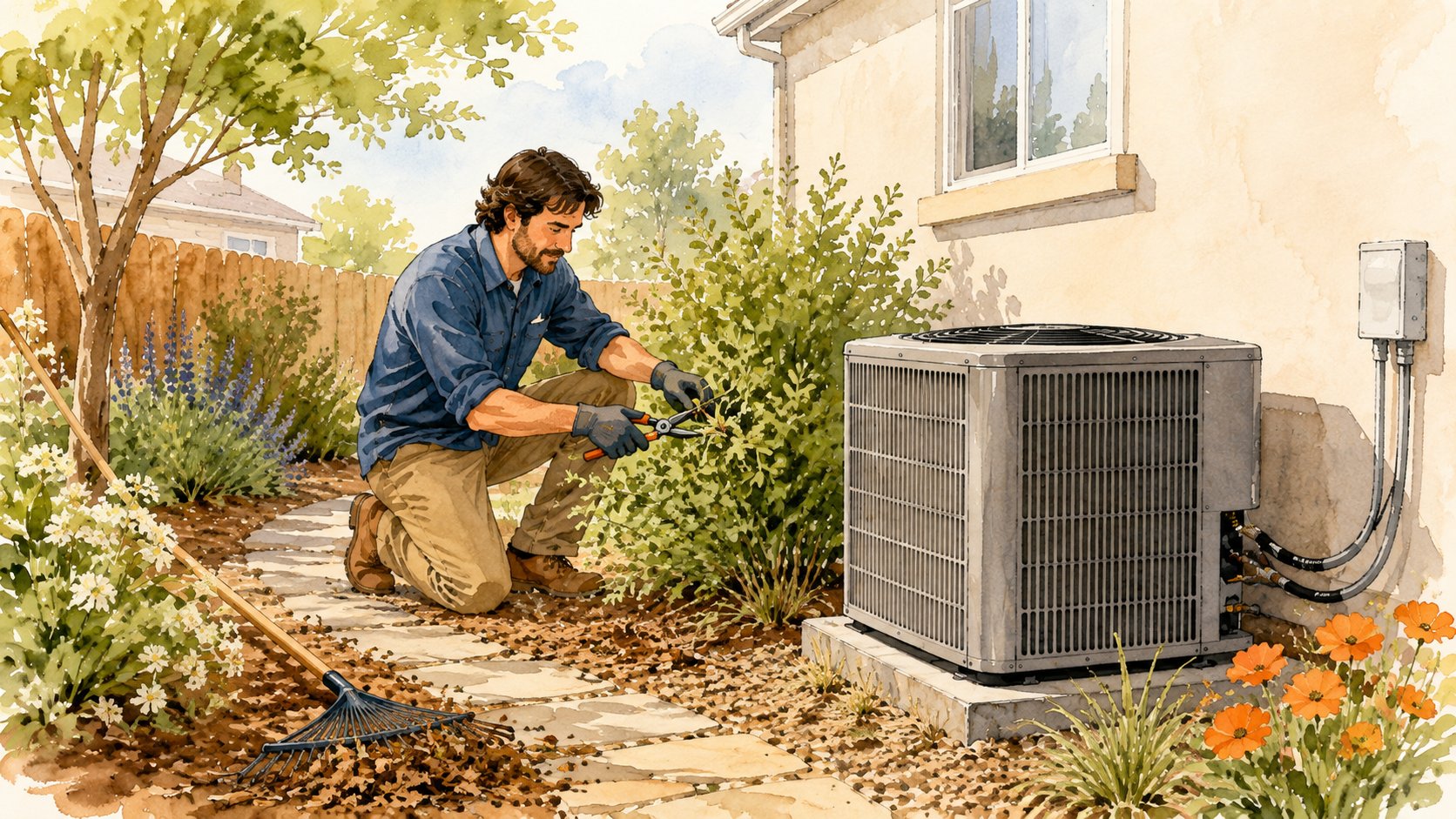
Your condenser dumps heat into the air around it, so it needs room to breathe. Rake out the leaves, pull the weeds, cut back the shrubs, and move the trash cans.
Aim for two feet of clear space on all sides and several feet of open air above. Then rinse the fins gently with a garden hose, top to bottom, on a low setting. Never point a pressure washer at those fins, because they bend flat in a second and bent fins choke airflow permanently.
Shut the power off at the outdoor disconnect box before you spray. If you’re not sure which box that is, skip the rinse and let a pro handle it during the tune up.
3. Put in a fresh filter
A dirty filter is the most common reason a healthy system underperforms. It starves the blower for air, which drops your cooling and can freeze the indoor coil solid on a hot day.
Most one inch filters want changing every 30 to 90 days during cooling season, though your interval depends on pets, dust, and how hard the system runs. Write the date on the cardboard edge so you’re not guessing in July.
4. Open the registers and check the return
Walk the house and open every supply register, including the rooms nobody uses. Then find the return grille, usually a big vent in a hallway or ceiling, and clear any furniture, curtain, or laundry basket away from it.
Vacuum the dust off the grille faces while you’re there. If one room never cools, that’s worth reading about in our guide to why one room stays hotter than the rest.
5. Follow the condensate drain
Air conditioning pulls a surprising amount of water out of your indoor air, and all of it leaves through one small drain line. Over a long off season, that line grows algae and gunk.
With the system running, find where the line exits, often near the outdoor unit or through an exterior wall, and confirm water is dripping out after 15 or 20 minutes. If nothing comes out, the line is likely blocked, and a blocked drain sends that water into your ceiling, wall, or attic insulation instead.
6. Give the thermostat a real look
Change the batteries if yours takes them. Confirm the mode is set to cool and the fan is on auto rather than on, since running the fan constantly can add humidity back into the house.
If yours is programmable or smart, rebuild the summer schedule now. Our post on whether smart thermostats are worth it in Elk Grove covers how much that scheduling matters here.
What to leave to a licensed pro
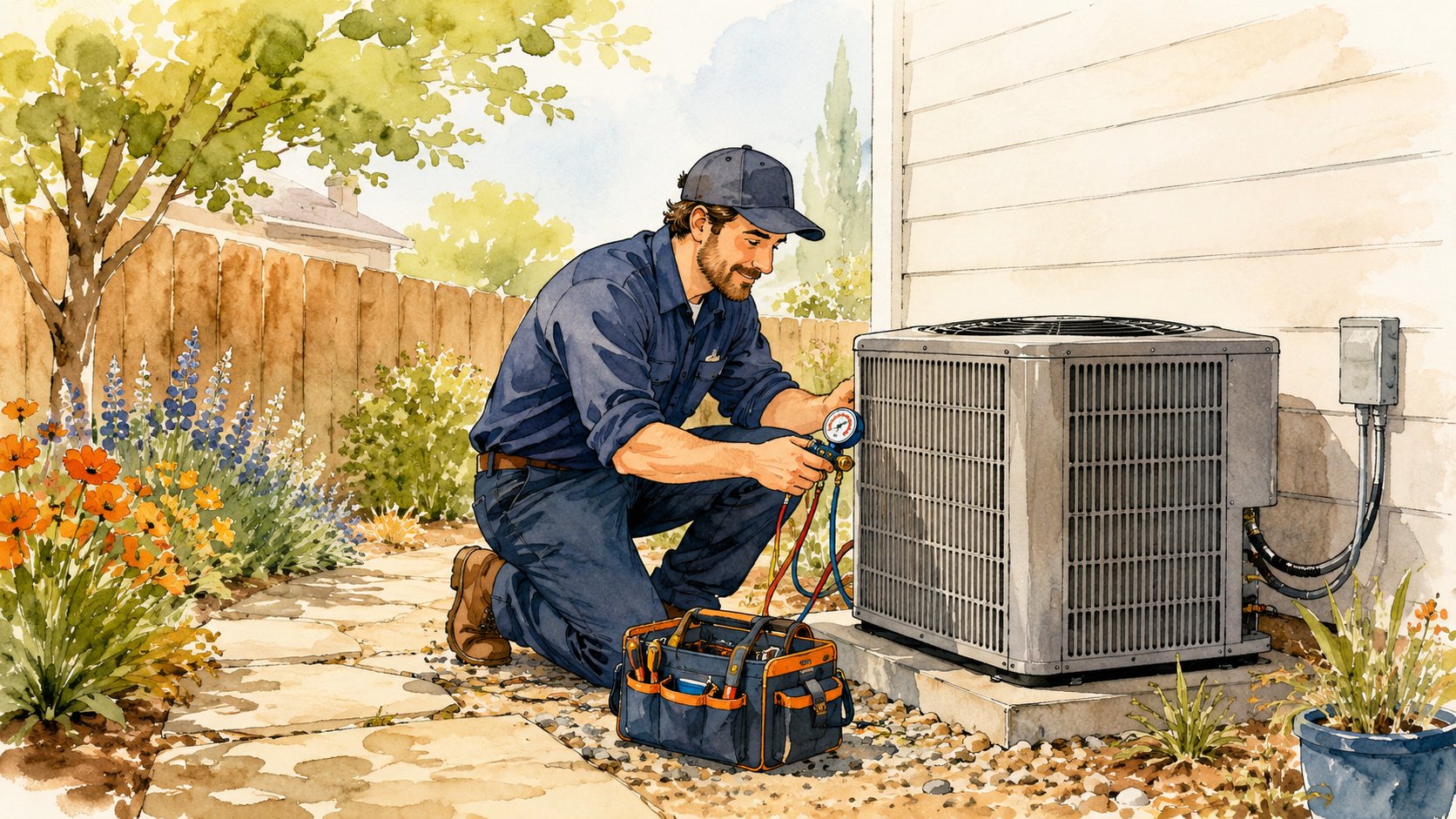
That list is the homeowner half. The other half needs gauges, meters, and a license, and trying it yourself usually turns a small repair into a big one.
A professional spring tune up should include checking refrigerant charge, testing capacitors and contactors, measuring amp draw on the motors, cleaning the evaporator coil, tightening electrical connections, and measuring the temperature split between return and supply air.
That last one is the honest report card. On a healthy system the supply air usually lands somewhere around 16 to 22 degrees cooler than the return air, though the exact figure moves with humidity and equipment.
Refrigerant is the big one to leave alone. It’s a sealed system, so if the charge is low there’s a leak, and topping it off without finding that leak just buys a few weeks. Our AC maintenance page covers what a full visit includes, and the AC tune up checklist spells out what a technician should touch.
Your spring timeline, week by week
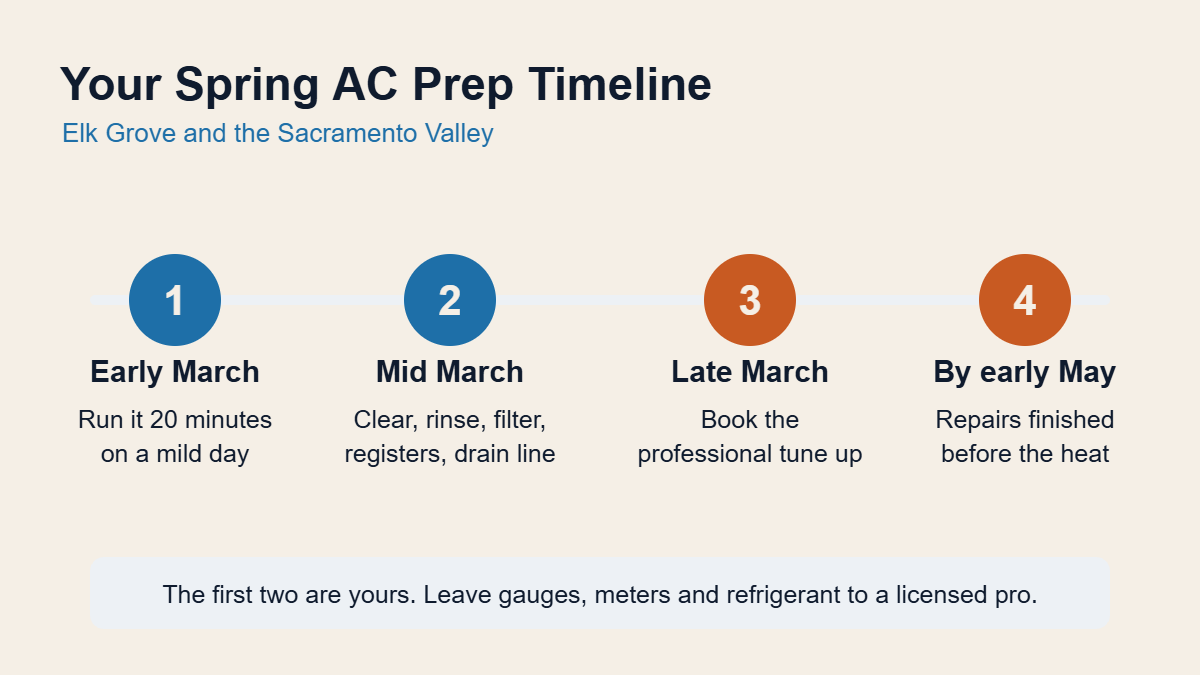
Spreading this over a month beats one panicked weekend in May.
- Early March: run the system for 20 minutes on a mild day and write down anything that sounds, smells, or feels off.
- Mid March: do the hands on work. Clear the condenser, rinse the fins, drop in a fresh filter, open the registers, check the drain line, and reset the thermostat.
- Late March: call and book the professional tune up. This is the part people put off, and it’s the part that fills up first.
- By early May: have any repairs the technician found actually finished, before you need the system.
The U.S. Department of Energy’s guidance on maintaining your air conditioner is a good plain read on why the annual visit tends to pay for itself.
A local example. A family off Elk Grove Florin Road ran their system in April, heard a faint buzzing outside, and shrugged it off because the house cooled fine. In late June the fan motor quit on a 107 degree Thursday and the house hit 91 by dinner. Same part all along. In April it was a routine appointment. In June it was three days of borrowed window units.
Common mistakes homeowners make in spring
These are the ones that come up over and over.
- Testing for two minutes. A short run proves the system turns on and nothing else.
- Closing vents in unused rooms. It feels efficient and it isn’t. Central systems are built for a set amount of airflow, and closing registers raises duct pressure and makes the blower work harder.
- Covering the outdoor unit and forgetting. If you wrapped it for winter, the cover has to come off before the first run.
- Pressure washing the coil. A gentle hose rinse helps, high pressure destroys the fins.
- Waiting for the heat to call. By then you’re in line behind people with no cooling at all.
- Ignoring a breaker that trips. Reset it once. If it trips a second time, leave it off and call somebody, because repeated tripping usually means a real electrical fault.
Key takeaways
Spring is the one stretch of the year when you can find AC problems calmly and on your own schedule. The Sacramento Valley doesn’t give you a gentle warmup into summer, so treat March and April as the deadline rather than the suggestion.
Do the six homeowner steps yourself, hand the gauges and meters to a licensed technician, and get any repairs finished before Memorial Day. A system that had a proper spring AC prep checklist run through it in March is one you stop thinking about in August.
Questions Elk Grove homeowners ask about spring AC prep
When should I start?
Early March is ideal here. You want mild weather for testing and open calendars for booking. If it’s already May, don’t skip it, just move faster.
Do I really need a professional tune up every year?
In this climate, yes. Systems in the Sacramento Valley run hard for five or six months straight, far more wear than the same equipment sees in a mild coastal town. Our post on how often to service your AC has the details.
My AC works fine. Is a spring AC prep checklist still worth the time?
That’s the best case for doing it. Working fine in March and working fine in July are different tests, and most breakdowns give warning signs months ahead.
What if the system doesn’t cool at all when I test it?
Better to find that in March than in August. Start with our guide to why an AC isn’t blowing cold air, then get a technician out while the schedule is still open.
How is this different from heat wave prep?
Spring prep is the slow, thorough version. Heat wave prep is the short list you run when a forecast turns ugly, and we cover it separately in how to prepare your home for the first heat wave.
Getting help with the parts you shouldn’t do yourself
Elk Grove AC Pros is a local HVAC information and lead request service. We’re not a licensed contractor, and this article is general information rather than professional HVAC advice. Systems and homes vary, so a licensed local pro should assess your specific equipment.
If your spring run through turned up a noise, a smell, a weak vent, or a dry drain line, get eyes on it while the calendar is still open. Request a free, no pressure quote and we’ll match you with a licensed local pro serving Elk Grove and the greater Sacramento area.