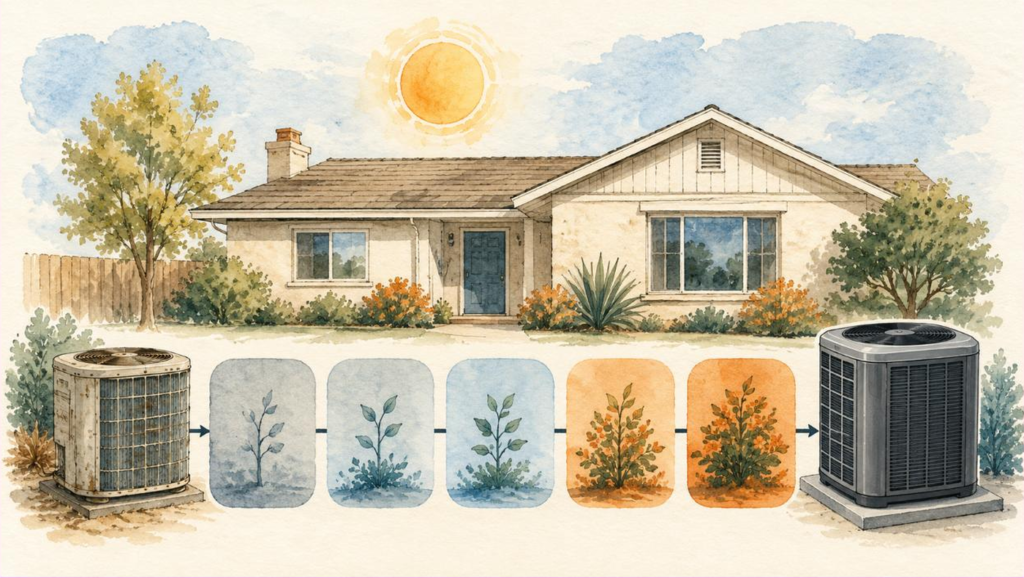
The unit outside your house has been running since before you moved in. It still kicks on, it still pushes cool air, and every July you catch yourself wondering whether this is the summer it finally quits.
That question comes up in Elk Grove more than almost any other. Nobody wants to replace a system that’s still working. Nobody wants to get caught with a dead one on a 105 degree Saturday either.
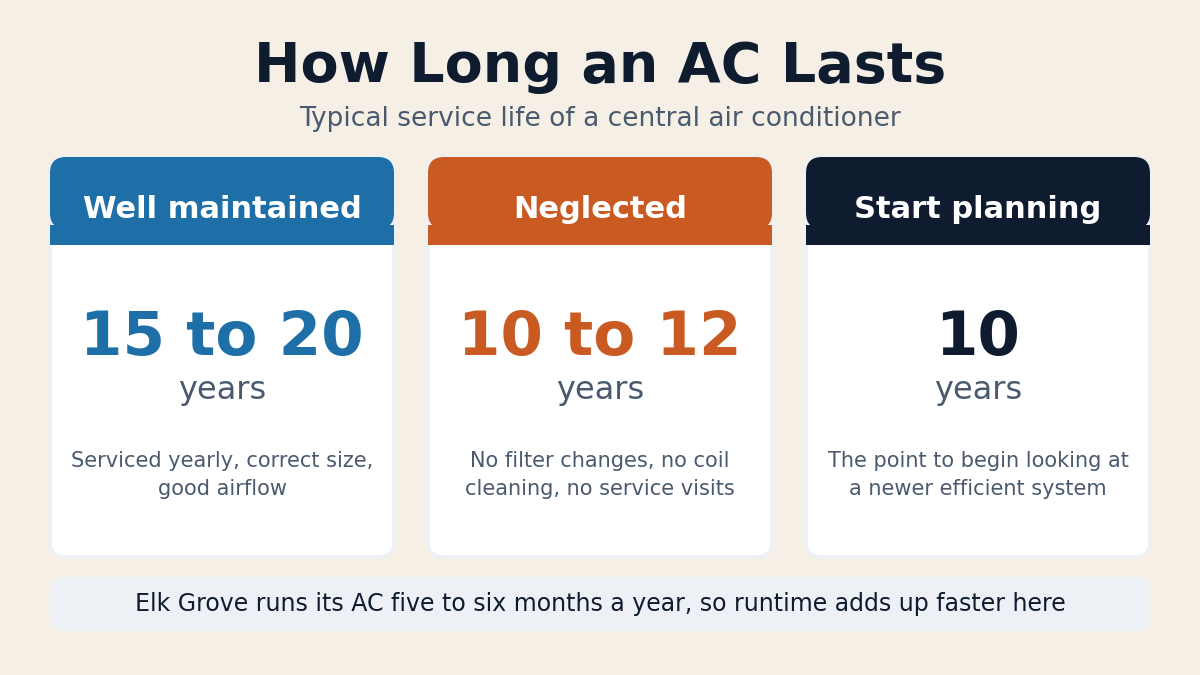
So here’s the honest place to start. Most central air conditioners run somewhere between 15 and 20 years. That’s a national average, though, and our valley summers lean hard on the low end of it. How long does an AC last in your particular house comes down to how it was installed, how often it’s been serviced, and how many hours a year it actually runs.
The number most people are looking for
According to ENERGY STAR, a typical central air conditioner lasts 15 to 20 years. A system that gets looked at every year, sits in decent airflow, and was sized correctly can reach the top of that range and sometimes push past it.
A system nobody ever touches is a different story. Units that go years without a filter change or a coil cleaning often start failing around the 10 to 12 year mark. Neglect can cost an air conditioner a third of its expected life, and it rarely announces itself until something expensive breaks.
So the honest answer is a range, not a number. Where your system lands inside that range is mostly up to how it’s been treated.

Why Sacramento Valley summers change the math
An air conditioner doesn’t age by the calendar. It ages by hours of runtime, and that’s where Elk Grove differs from most of the country.
Our cooling season stretches roughly five to six months. It usually wakes up in May, punishes everyone from late June through August, and often keeps going deep into October. A unit in a mild coastal town might run a few hundred hours across a whole summer. Ours run thousands.
On top of the hours, there’s the dust. Between the dry summer air, the ag fields around the edges of town, and the construction that never really stops in south Elk Grove, outdoor coils here collect grit fast. A dirty coil makes the compressor work harder, and the compressor is the part that decides whether a system is worth saving.
None of that means your AC is doomed to die early. It does mean that how long an AC lasts here depends more on upkeep than it would almost anywhere else in the state. The maintenance that’s optional in a mild climate isn’t really optional in ours.

What actually decides how long your AC lasts
Four things move the needle more than the brand on the side of the unit.
Installation quality
This one is bigger than most homeowners realize. A system charged incorrectly, connected to leaky ducts, or set on a poor pad starts its life at a disadvantage and never fully recovers. A great unit installed badly will lose to an average unit installed well every time.
Regular maintenance
A yearly visit catches the small stuff: a weak capacitor, a slow refrigerant leak, a coil that needs washing, a contactor starting to pit. Those are cheap fixes when they’re caught early and brutal ones when they’re not. Our guide to what skipping AC maintenance really costs walks through the four ways it adds up.
Correct sizing
An oversized system short cycles, snapping on and off all day instead of running steady. Every start is stress on the compressor. An undersized one runs nonstop through a heat wave and never catches up. Both wear out sooner than a system matched to the house.
How you run it
Setting the thermostat to 65 on a 108 degree afternoon doesn’t cool the house faster. It just keeps the unit running flat out for hours. Steady, reasonable settings are easier on the equipment than dramatic swings.

Signs your AC is getting close to the end
Systems rarely die without warning. They tend to send signals for a season or two first.
- Repairs are stacking up. Two or more service calls in a single cooling season is a real signal, not bad luck.
- Your bills climb while your habits stay the same. Aging systems quietly lose efficiency year over year.
- The house takes noticeably longer to cool than it used to, or certain rooms stop keeping up.
- The unit runs almost constantly on hot afternoons without hitting the setpoint.
- It uses R22 refrigerant. That’s an older type, it’s no longer produced, and what’s left is expensive.
- New noises show up: rattling, grinding, or a hum that wasn’t there last year.
One of these on its own is usually a repair. Three or four together on a system past 15 is a system telling you to start planning.
The 10 year mark and the efficiency question
ENERGY STAR suggests that once a cooling system passes 10 years, it’s worth looking at what a newer high efficiency unit would do for your energy use. Their guidance points to savings of up to 20 percent on heating and cooling costs with a correctly installed ENERGY STAR system.
Read that as “start paying attention,” not “replace it today.” A healthy 12 year old system that’s been serviced every spring can have years left in it.
What the 10 year mark really buys you is time to plan. Replacing on your own schedule in the shoulder season is a very different experience than replacing in the middle of an August heat wave when every company in the county is booked. If you’re weighing efficiency levels, our breakdown of what SEER rating you actually need in Elk Grove covers where the extra money stops paying you back.
Common mistakes that cut an AC’s life short
Most of the systems that die young in Elk Grove got there the same handful of ways.
- Skipping the annual service because nothing seems wrong. By the time something seems wrong, the cheap window has closed.
- Letting shrubs, fence panels, or stacked patio furniture crowd the outdoor unit. It needs open air on all sides to dump heat.
- Running a filter until it’s gray. A choked filter starves airflow and can freeze the coil.
- Ignoring a new noise for a whole season. Small mechanical problems don’t stay small.
- Replacing only the outdoor unit and pairing it with a much older indoor coil. Mismatched equipment underperforms and wears faster.
- Picking a bid purely on price without checking the license or the load calculation.
Avoid those six and you’ve done most of what a homeowner can do to change how long an AC lasts. The rest is out of your hands.
When repairing stops making sense
There’s no perfect formula, but there’s a reasonable way to think about it. Weigh what the repair costs against the age of the system and what you’d realistically get out of it afterward.
A small part like a capacitor on an eight year old unit is easy math. A compressor or a major refrigerant leak on a 17 year old unit is a much harder call, because you’re spending real money on a system that may not give you another summer. Our full repair or replace guide walks through that decision in more detail.
When the numbers point toward replacement, a licensed local pro should run a proper load calculation on your home rather than swapping in whatever size was there before. You can read what’s involved on our AC replacement page, and if you’d rather squeeze more years out of what you have, regular AC maintenance is where that starts.
Key takeaways
- Most central air conditioners last 15 to 20 years. Neglected ones often fail closer to 10 to 12.
- Elk Grove’s long cooling season and dusty summers put more hours and more grit on a system than most of the country does.
- Installation quality, yearly maintenance, correct sizing, and how hard you run it matter more than the brand.
- Past 10 years, start planning. Past 15 with stacking repairs, start pricing.
- Replacing on your schedule beats replacing in the middle of a heat wave.
Frequently asked questions
How long does an AC last in Elk Grove compared to elsewhere?
Usually a little shorter. The national range of 15 to 20 years assumes an average cooling season. Ours runs five to six months, so a system here piles up runtime faster than the same unit would in a milder climate. Good maintenance closes most of that gap.
Is a 15 year old AC too old to keep?
Not automatically. A 15 year old system that’s been serviced every year, cools well, and hasn’t needed major repairs can keep going. It’s the combination of age plus repeat repairs plus rising bills that says it’s time.
Does yearly maintenance really add years?
It’s the single biggest thing you control. Clean coils, good airflow, correct refrigerant charge, and early catches on failing electrical parts all reduce the load on the compressor, which is what usually ends a system’s life.
How do I find out how old my system is?
Look for the manufacturer’s data plate on the outdoor unit. The serial number usually encodes the build date, and most brands publish how to read it. A technician can tell you in about a minute during a service visit.
When’s the best time to replace an AC in Elk Grove?
Spring or fall. Schedules are open, you’re not making a rushed decision in 100 degree heat, and you have time to compare bids properly.
A quick note on who we are
Elk Grove AC Pros is a local HVAC information and lead request service. We’re not a licensed contractor, and this article is general information rather than professional HVAC advice. Ages, costs, and equipment conditions vary a lot from house to house, so a licensed local pro should assess your specific system before you make a call on repairing or replacing it.
If you’re staring at an aging unit and want a straight answer about what it has left, request a free, no pressure quote and we’ll connect you with a local pro who serves Elk Grove and the greater Sacramento area.