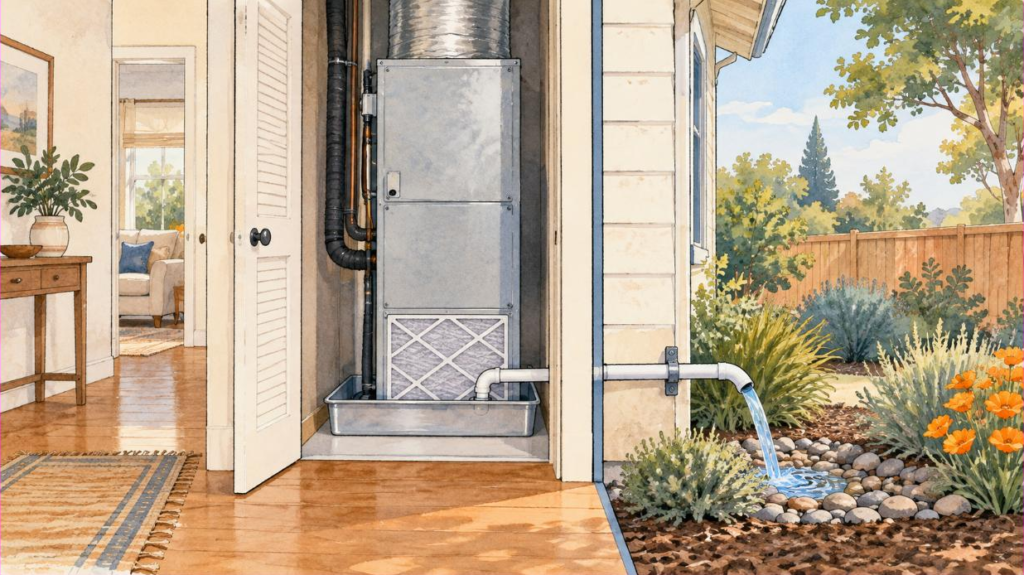
The first clue is almost never the pipe itself. It’s a brown ring spreading across the hallway ceiling, or a damp patch of carpet outside the closet where the air handler lives, or an air conditioner that quits at two in the afternoon on a 104 degree day and won’t restart no matter what you do at the thermostat.
Behind all three you’ll usually find the same skinny white pipe. Your AC pulls a startling amount of water out of the air during an Elk Grove summer, and that water has exactly one way out of the house. Plug the way out and it goes looking for a second option, which is generally your drywall.
A blocked drain is one of the most common cooling calls around here between June and September, and one of the easiest to catch early. Here’s what an AC condensate drain clog looks like from inside your house, and where the line sits between a Saturday morning job and a job for a pro.
What your AC is actually doing with all that water
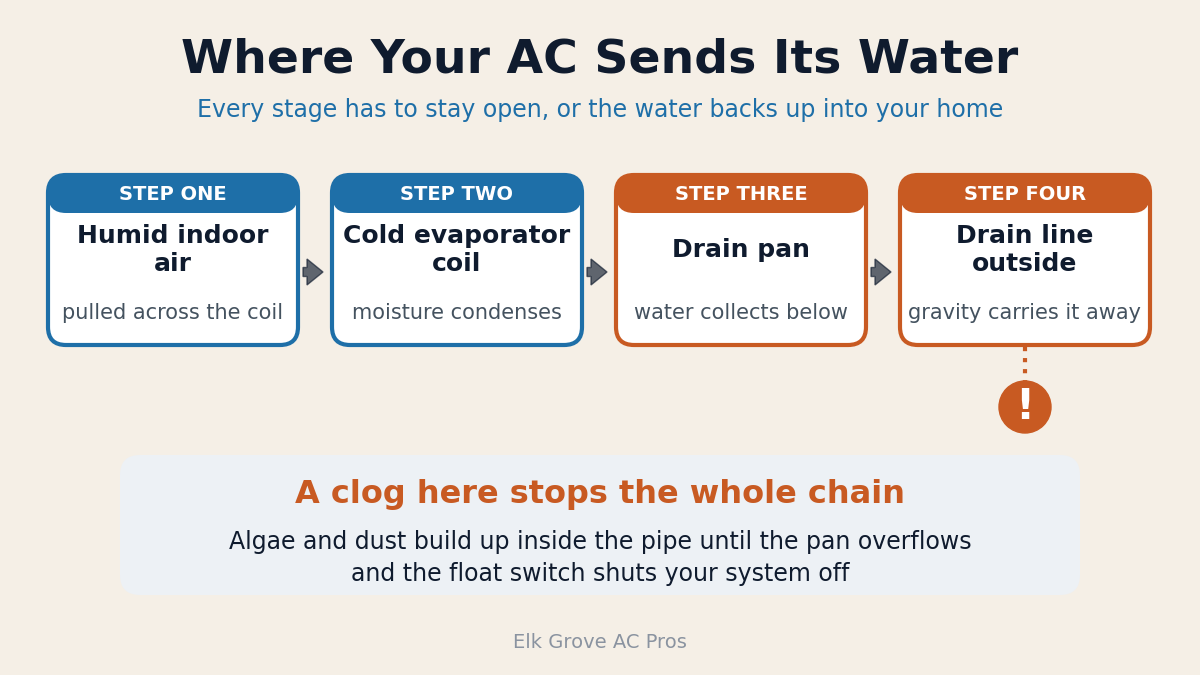
Cooling your house is only half of what your air conditioner does. The other half is pulling humidity out of the air, whether you asked for it or not.
Warm indoor air passes over the cold evaporator coil inside your air handler, and moisture condenses on it the same way it beads up on a glass of ice water. The drops run down the coil into a shallow drain pan underneath.
From that pan, a small PVC pipe carries the water by gravity to a spot outside your home, or into a nearby household drain. On a hot stretch a system can move several gallons of water a day through that pipe without you ever noticing. That’s the whole design, and it works beautifully right up until the pipe stops draining.

The signs of an AC condensate drain clog
Plenty of people find out the hard way, when the ceiling tells them. But there are earlier tells if you know where to look.
Water around the indoor unit
A puddle on the floor, a ring of damp near the closet door, or standing water in the drain pan itself all point the same direction. Water in the pan means water isn’t leaving the pan. We covered the fuller picture on indoor leaks in why your AC is leaking water.
A stain on the ceiling or wall
If your air handler sits in the attic or an upstairs closet, the first thing you see is often a yellow or brown patch on the ceiling below. By the time a stain shows through paint, the water has been up there a while.
The system shuts off and won’t come back
Most systems installed in the last couple of decades have a float switch, a small safety device that cuts power when water rises too high in the pan. It isn’t broken. It’s doing its job, and it’s the reason your ceiling is still dry.
A clammy house or a musty smell
When the drain backs up, the coil can’t shed moisture properly, so the air feels heavy even after the thermostat says you’ve hit your number. Standing water also grows algae fast, so vents that smell like a damp basement point the same direction.
Any one deserves a look. Two or more, and you almost certainly have a blockage.
Why these lines clog so fast around Sacramento
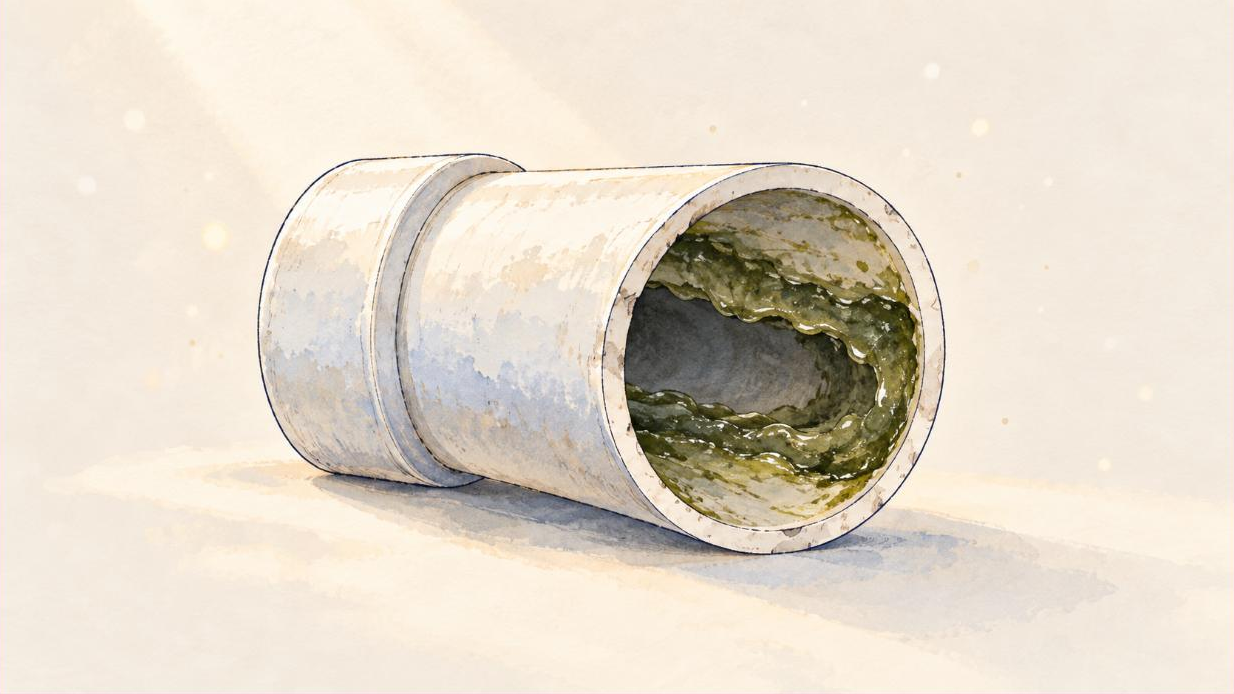
Algae is the main culprit. The inside of that pipe stays dark, wet, and warm for months, which is close to perfect growing conditions, and a slick film builds on the pipe walls until the opening chokes down to nothing.
Dust is the accomplice. Between farm ground, construction, and five months without meaningful rain, a lot of fine grit works its way through the return and onto a wet coil. Wet dust turns to sludge, sludge slides into the pipe, and sludge plus algae makes a plug.
Then there’s the sheer length of our cooling season. An AC somewhere mild might run hard for eight or ten weeks a year. Ours work from May into October, so the drain line spends far more time wet than the same pipe would almost anywhere else, and more wet time means more growth.
Pitch matters too. The pipe drains on gravity alone, so if the run sags anywhere between the pan and the exit, water pools in that low spot and the plug starts right there.

What you can safely try yourself
A partial blockage near the outdoor end is often within reach of a homeowner with an hour and a shop vacuum.
Turn the system off first. Shut it down at the thermostat and at the breaker, so nothing is making new water while you work.
Then find the outdoor end of the line: a small white or grey PVC pipe, usually about three quarters of an inch across, poking out of an exterior wall near the outdoor unit.
Vacuum from that end. Seal a shop vacuum hose over the opening with your hand or a wet rag, run it a minute or two, and see what comes out. Most seasonal clogs give up right here. Don’t try it from the indoor end, since that pulls water and gunk toward the equipment instead of away from it.
Empty the pan next, then flush the line. Near the indoor unit there’s usually a capped access fitting on the pipe just past the pan. Pour in a cup of distilled white vinegar, give it half an hour, then chase it with water and confirm it runs out the far end.
If the water still refuses to move, stop there and book AC repair. Forcing a stubborn line is how a small nuisance becomes a cracked pan, a snapped fitting, and a much bigger invoice.
When the float switch has already shut you down
If your AC is dead and the breaker looks fine, check the drain pan before you assume the worst about the compressor. A tripped float switch is one of the most common reasons a perfectly healthy air conditioner refuses to start on the hottest afternoon of the year.
The switch resets on its own once the water level drops, so clearing the line and drying the pan often brings everything back to life. If it trips again within a day or two, the line isn’t really clear, and someone needs to chase the blockage further up the run.
What you should never do is bypass that switch to force the system to run. It’s the only thing standing between a backed up pan and a repair that includes drywall, insulation, and flooring.

Common mistakes that turn a small clog into a big one
Waiting out the ceiling stain. A faint mark doesn’t stay faint. Water that has reached drywall is already in the insulation above it.
Reaching for bleach. Straight bleach can be hard on metal pan components and glued joints over time, and distilled vinegar does the same job with less collateral damage.
Shoving a coat hanger down the pipe. More often than not it packs the clog tighter, and it scratches the pipe wall so the next film has something to grip.
Clearing the line but ignoring the pan. Water left sitting there keeps the float switch tripped and gives the next clog a head start.
Treating it as a one time event. If a line clogged this July, it will clog again, because nothing about the conditions that caused it has changed. That’s the whole argument for regular AC maintenance instead of waiting for the next surprise.
How to keep the line clear for the rest of the season
Flush the line monthly while you’re cooling. A cup of distilled vinegar down the access fitting takes five minutes and heads off most of what we’ve described.
Change your filter on schedule. Less dust reaching the coil means less sludge heading for the pipe, and the Department of Energy notes that a dirty filter makes a system work harder than it should. The same dust story plays out on the coil, which we dug into in AC coil cleaning.
Get the system serviced before summer arrives. A real tune up includes clearing and testing the drain, checking the pan for rust, and confirming the float switch actually works.
And glance at the outdoor end on hot days. If the AC has run for hours and nothing has dripped out, the line probably isn’t flowing.
Key takeaways
- Your AC removes water as well as heat, and that water needs an open path out of the house.
- Water in the pan, ceiling stains, a clammy house, a musty smell, or a system that shuts itself off all point toward a blocked line.
- Algae, valley dust, and a five to six month cooling season make an AC condensate drain clog especially common here.
- A shop vacuum at the outdoor end plus a vinegar flush clears most seasonal blockages.
- Never bypass the float switch. It’s protecting your ceiling.
Frequently asked questions
How do I know for sure that I have an AC condensate drain clog?
Run the system on a hot day and watch the outdoor end of the drain pipe. Water should drip out steadily after a long cooling cycle. Nothing coming out, combined with water standing in the indoor pan, is about as clear as the evidence gets.
Can I pour bleach down the drain line?
Many people do, but we’d steer you toward distilled white vinegar instead. It handles algae well and it’s gentler on the pan, the fittings, and anything the line empties onto.
How often should the line be flushed?
Once a month during cooling season suits most Elk Grove homes. If your system has clogged before, or your air handler lives in the attic where a leak does the most damage, don’t skip a month.
Is a clogged drain line expensive to fix?
It’s typically one of the smaller repairs, especially next to the water damage it causes when ignored. Costs vary by system and by where the blockage sits, so get a clear quote before work starts.
Getting help with it
Elk Grove AC Pros is a local HVAC information and lead request service. We’re not a licensed contractor, and this article is general information rather than professional HVAC advice. Every system is a little different, so a licensed local pro should assess yours before any work happens.
If your line is backed up, your pan is full, or you’d rather not go poking around an attic in August, we can connect you with a local pro. Request a free, no pressure quote and someone will take a look at what’s actually going on.