
You wipe down the coffee table on Saturday. By Monday there’s a soft gray film on it again. The windows have been shut since June, the AC runs almost nonstop, and somebody in the house has been sneezing since July.
That’s an ordinary summer in Elk Grove, and it’s usually not a mystery. When it’s 104 outside, your home turns into a mostly sealed box, and whatever floats around inside just keeps circulating.
Here’s the part most homeowners get backwards. The fixes that work best are cheap and boring, and the gadget you were about to buy belongs at the end of the list. The EPA’s order of operations is to remove the sources of pollution first, bring in clean outdoor air second, and filter what’s left third.
Why indoor air quality in Elk Grove is its own problem
Plenty of the country gets to open a window in July. We don’t. From roughly June through September, your home stays closed, which means the air you breathe has been recycled through your ductwork over and over.
Layer on what’s specific to this valley. Wildfire smoke drifts in and settles because the valley traps it. Dust and pollen blow off the open ground around the edges of town. Newer tract homes in places like Laguna Ridge are built tight, which is great for your power bill and not great for stale air.
Older homes have the opposite issue. They leak in the wrong places, pulling dusty attic air into the living room instead of fresh outdoor air.
Either way, your air conditioner is now the main thing moving air through your house, so it’s the main lever you have. That’s why indoor air quality in Elk Grove is really an HVAC conversation, not a shopping conversation.
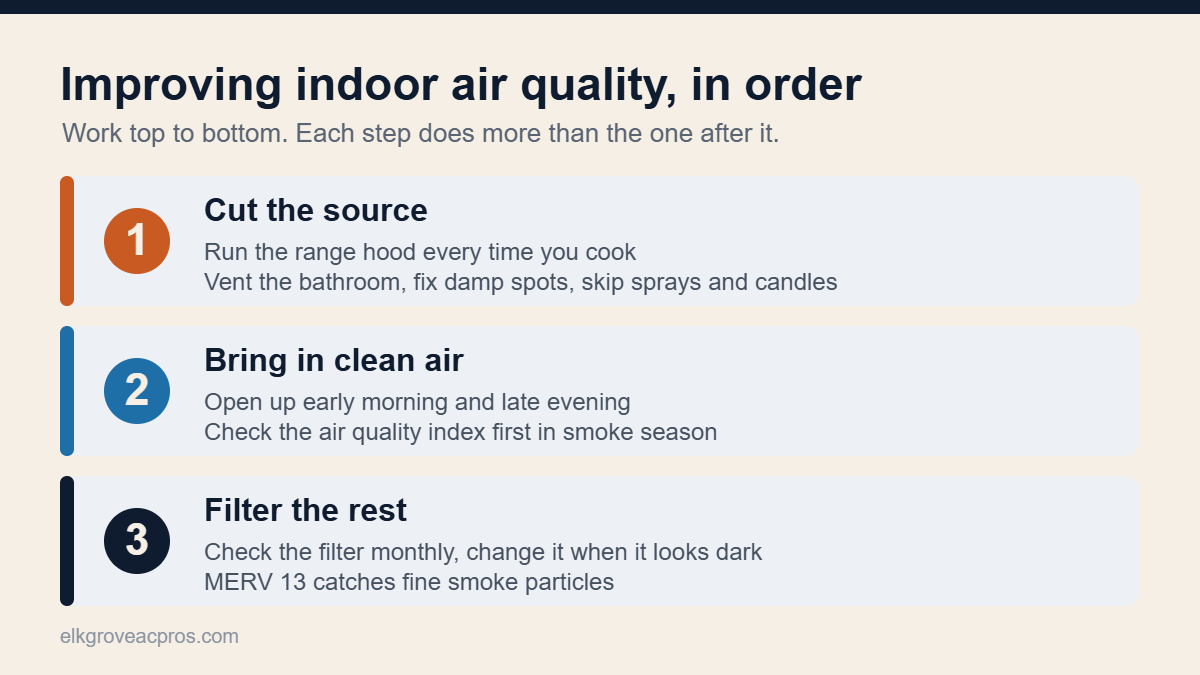
Step one, cut the pollution at the source
The least exciting advice, and the most effective. If something in your house is pumping particles or fumes into the air, no filter keeps up forever.
Walk the house and look for the usual suspects. Cooking on a gas range with no vent hood running. Scented plug ins and aerosol sprays. Candles. A damp bathroom that never gets a fan. A door to the garage that gets propped open. Fresh paint or new furniture giving off fumes for weeks.
Two habits do more than anything you can buy. Run the range hood every single time you cook, and let the bathroom fan run about 20 minutes after a shower.
One catch worth knowing: a lot of over the range microwaves just blow the air back into the kitchen instead of outside. If yours does that, it isn’t ventilating anything, it’s stirring.
Then handle dust the boring way. Damp dust instead of dry dusting, vacuum with a sealed HEPA bag, and wash bedding in hot water. Dust you pick up never reaches your filter.

Step two, bring in clean outdoor air when you can
Here’s something that surprises people. Most forced air systems, including yours, don’t bring in outdoor air at all. They pull air from your rooms, cool it, and send it back. Fresh air is on you.
In Elk Grove, the opening is early morning and late evening, when the delta breeze knocks the temperature down. Twenty minutes of open windows on both sides of the house flushes out a surprising amount of stale air for free.
But check the outdoor air first. On a smoky or high ozone day, opening up makes things worse. AirNow and your phone’s weather app both show the local air quality index, and it’s worth a glance before you crack a window in August.
Same rule goes for a whole house fan. On a smoke day it’s a very efficient way to pull the smoke inside.
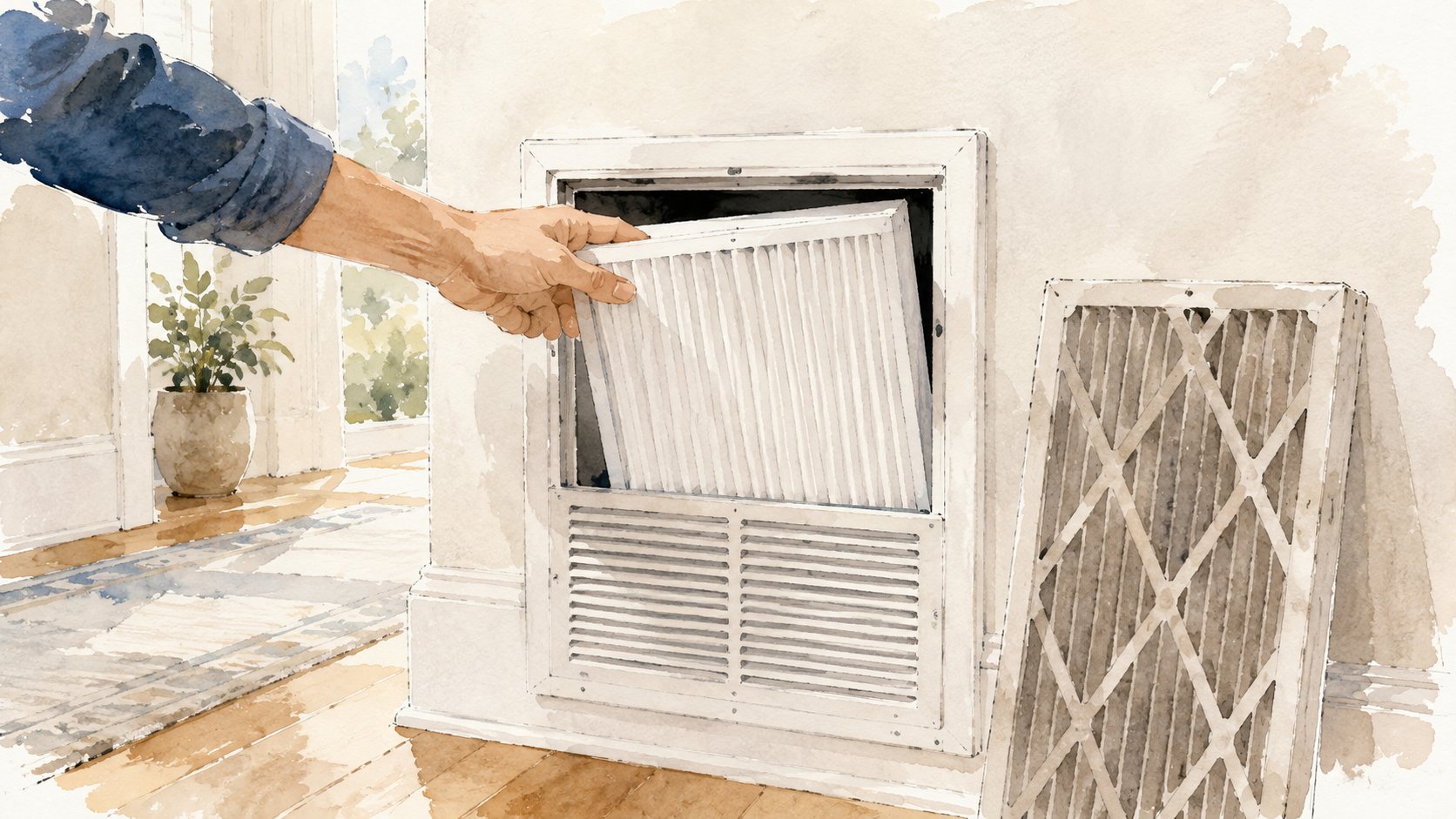
Step three, filter what’s left
The filter in your return vent has two jobs. Its first job is protecting the blower and the coil from dust, and its second job is cleaning the air you breathe. How well it does the second one comes down to the MERV rating.
MERV is a simple scale. Higher number, finer particles caught. A basic cheap filter stops lint and big dust. Around MERV 8 to 11 you start catching pollen and mold spores. The EPA suggests MERV 13 or higher during smoky stretches, because that’s the range that grabs fine smoke particles.
Know the tradeoff before you grab the highest number on the shelf. A denser filter restricts airflow, and on the wrong system that means weak cooling, a frozen coil, and a strained blower. Most home systems handle MERV 13 fine if the filter gets changed often enough, but a licensed tech can tell you what yours will tolerate.
Change intervals matter more than people think. A standard one inch filter usually wants replacing every 30 to 90 days, and closer to 30 during heavy pollen or smoke. Thicker media filters go much longer. The honest method is to pull it out once a month and look at it, then replace it when it’s dark and matted rather than waiting on a date.
Fit matters too. If there’s a gap around the frame, air takes the easy path and slips right past, and your expensive filter is doing almost nothing.
One more free upgrade: set your thermostat fan to circulate or On for part of the day. More air through the filter means more particles caught, at the cost of a little more electricity.
What about your ducts and coils?
A dusty blower wheel and a grimy evaporator coil genuinely hurt airflow and can add a musty smell to every room. Keeping those clean is part of a normal AC maintenance visit. We covered that in our guide to AC coil cleaning.
Duct cleaning is different. The EPA’s position is that ducts should be cleaned when there’s a reason, not on a routine schedule. The reasons that count are visible mold inside the ducts, evidence of pests, or so much debris that it’s blowing out of your registers.
Often the real problem isn’t dirty ducts, it’s leaky ones. A disconnected duct in a 140 degree attic pulls insulation fibers and attic dust straight into your air stream, and no amount of scrubbing fixes that. Our full breakdown lives in is air duct cleaning worth it, and the service itself is on our air duct cleaning page.

Do portable air cleaners actually work?
They do, within limits worth knowing before you spend money.
A true HEPA portable unit pulls particles out of one room nicely, as long as it’s rated for a room that size. Check the clean air delivery rate on the box against your square footage. An undersized unit in a big living room is mostly white noise.
Put it where you spend the most hours, usually the bedroom. Eight hours of clean air a night beats a machine humming in an empty hallway.
Two cautions. Skip anything that makes ozone on purpose, since ozone irritates lungs. And a particle filter does little for odors unless it holds real activated carbon.
Common mistakes we see
A few of these come up constantly.
Buying a purifier while the AC filter goes six months without a change. The filter your whole house breathes through beats a machine in one corner every time.
Grabbing the highest MERV on the shelf without a thought for the system. If your cooling feels weak right after a filter swap, that’s your clue.
Treating a stuffy feeling as a reason to open windows in smoke season. Stuffy and smoky feel similar from inside. Check the number, not the vibe.
Ignoring moisture. A slow leak, a soggy crawl space, or a clogged condensate line feeds mold, and mold is an air quality problem no filter will solve. If you’re seeing water, read our post on why your AC leaks water.
One pattern worth recognizing. A family in an older Elk Grove neighborhood spent a whole summer sure they needed duct cleaning, thanks to dust and allergy flare ups. The filter was a thin builder grade one that hadn’t been swapped since spring, the return grille had a gap letting air bypass it, and the bathroom fan hadn’t worked in years. A better filter, a snug fit, and a working fan handled most of it.
Key takeaways
- Work in order: remove the source, ventilate with clean outdoor air, then filter.
- Your central system recirculates indoor air. It doesn’t bring fresh air in on its own.
- Check the air quality index before opening windows in smoke season.
- A snug filter, changed on time, does more than most gadgets.
- MERV 13 catches fine smoke particles, but confirm your system can handle it.
- Clean ducts when there’s a real reason. Fix leaks and moisture first.
Questions Elk Grove homeowners ask
Does running my AC clean the air in my house?
Partly. Air passing through the filter gets cleaned, so more runtime means more filtering. But the system recirculates indoor air rather than bringing fresh air in, so it can’t dilute what’s already inside.
What MERV filter should I use?
MERV 8 to 11 handles everyday dust and pollen. MERV 13 is the range that captures fine smoke particles, and it’s a reasonable target for most homes here, provided you change it on schedule and your system can move air through it.
Will duct cleaning fix my allergies?
Sometimes, but it’s rarely the first move. Unless there’s visible mold, pests, or debris blowing from your vents, filtration and source control deliver more for less.
How often should I have my system checked?
Once a year, ideally in spring before the first real heat wave. That visit is when a tech catches a dirty coil, a weak blower, or a duct problem quietly hurting indoor air quality in Elk Grove homes.
Where to start this week
Look at your filter today. Run the range hood tonight. Open the windows tomorrow morning if the air outside is clean. Those three cost almost nothing and move the needle more than anything you can order online.
If dust and smells persist after that, the system itself is worth a look. Weak airflow, a dirty coil, and leaky ducts all show up as complaints about indoor air quality in Elk Grove homes long before they show up as a breakdown.
Elk Grove AC Pros is a local HVAC information and lead request service. We’re not a licensed contractor, and this article is general information, not professional HVAC advice. A licensed local pro should assess your specific system before you spend money on it.
Want a second opinion on your air? Request a free, no pressure quote and we’ll connect you with a local pro who can walk your home and tell you what’s going on.